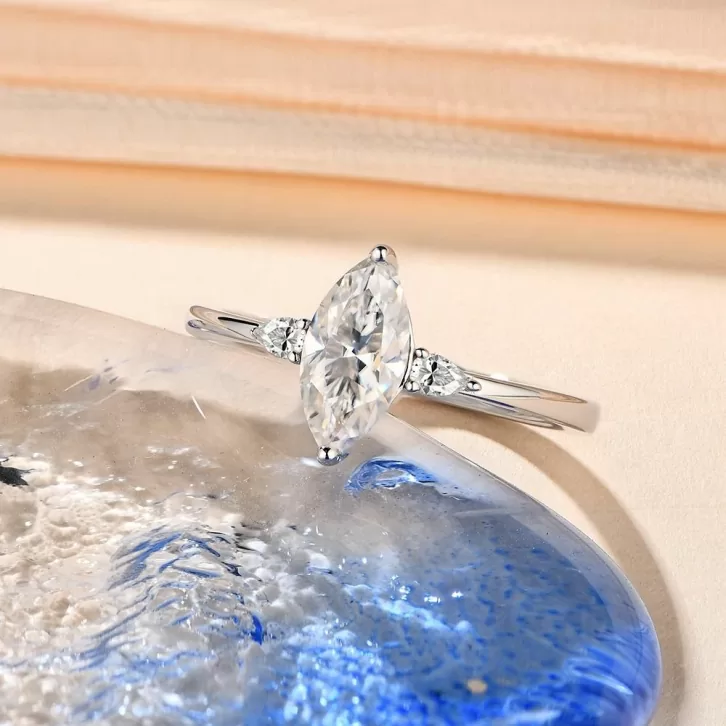
Walk into any jeweller and you will meet two kinds of stones: ones that arrive with an independent grading (per GIA's diamond grading standards) report, and ones that do not. The price gap can be noticeable, and it is tempting to save money on an uncertified stone. The right choice depends on what the report is actually giving you, and on how much you care about the stone long after the purchase day.
What a certificate guarantees
A grading report from a laboratory such as the GIA or AGS is an independent record of the stone's measured properties: carat weight, colour grade, clarity grade, cut proportions, and often a plot of the inclusions. Crucially, it does not assign a value and it is not a "good stone" stamp. It is a measurement, taken by people who did not sell you the stone.
That measurement is the trust mechanism. Two jewellers quoting a 1.00 carat, F, VS1 diamond are now quoting against the same definition. Without a report, "VS1" or "near colourless" is whatever the seller says it is. Our diamond clarity grades explained guide shows how wide the gap between grades really is, which is exactly why the definition matters.
How much does a grade actually move the price?
More than most buyers expect. A stone graded G colour can cost noticeably more than one graded J, even though the difference is invisible to many untrained eyes, and a VS1 commands more than an SI2. Without a report, a seller can label a stone "near colourless" and charge G money for a J. The report is what prevents that gap from swallowing your budget. This is the same reason our D-to-Z colour grading guide warns against buying colour sight-unseen.
What an uncertified diamond saves you
Uncertified stones cost less for three reasons. The seller has not paid the grading fee, they are taking on the grading risk themselves (a stone may grade lower than hoped), and there is no independent document to justify a higher price. For a small, everyday stone bought from a jeweller you trust, that saving can be genuine.
Uncertified diamonds also make sense in situations where the report adds little: very small accent stones under roughly 0.15 carats, where a full report is uneconomical; coloured or fancy stones sold on appearance rather than grade; and pieces bought for design rather than investment. For budget planning across the whole ring, see engagement ring budget allocation.
The risks of going uncertified
The downside is asymmetric. If the seller grades the stone generously, you overpay by a margin that is hard to spot. If you ever resell or insure, an uncertified stone is harder to value because every appraiser has to re-grade it on the spot. In an insurance claim, an independent report is the document an insurer reaches for first; see our engagement ring insurance cost guide for how reports tie into cover.
There is also the treatment risk. Fracture-filled or clarity-enhanced stones can look clean without a report to flag the treatment. A laboratory report will note such treatments; a seller's word usually will not. Our piece on clarity-enhanced and fracture-filled diamonds explains what treatments a report would expose.
Middle-ground options
You do not have to choose between a GIA report and no paper at all. Some stones come with a report from a more affordable laboratory, which is useful for verification but is graded to a looser standard. Others can be sent for grading after purchase, at your cost, if you want certainty.
If you are buying online, the safest structure is: loose stone, independent report, and a return window long enough to send the stone for verification yourself. Our engagement ring online checklist walks through that exact sequence.
Reading a report in five minutes
If you are handed a report, do not read it cover to cover. Check four things: the carat weight against the stone on the scales, the colour and clarity grades, the cut grade (for rounds), and the comments section for treatments or laser inscriptions. Everything else is supporting detail. Our guide to comparing two certificates walks through that scan in more depth.
Which should you pick?
Buy certified when the stone is a meaningful purchase, when you care about resale and insurance, or when you cannot see the stone in person. Buy uncertified only when you trust the seller, the stone is small or decorative, and the price genuinely reflects the missing paper. In almost every other case, the report pays for itself the first time you need it.
As a final rule, if a seller hesitates to show you the report, lets you photograph it, or explain the grade in plain language, that hesitation is itself the answer. A genuine, well-graded stone is easy to document; the reluctance is what tells you to look elsewhere.
Related Reading
- HPHT vs CVD Lab-Grown Diamonds: The Basics Buyers Ask
- When Your Ring Size Changes: Day to Day, Season to Season
- How Lab-Grown Diamonds Are Priced
Frequently Asked Questions
Is moissanite a good diamond alternative for retail buyers?
Yes for price-sensitive customers who want brilliance and hardness. Moissanite ranks 9.25 on the Mohs scale, holds up to daily wear and costs a fraction of a natural diamond of the same size, so it resells fast in bridal and fashion lines.
What is the minimum order for wholesale moissanite?
MOQ starts at 50 pieces per design for stock items. Custom cuts and private-label settings usually start at 100–300 pieces depending on the mold.
Do you provide certificates with moissanite stones?
Yes. Every parcel ships with GRA or IGI documentation listing carat weight, color grade and cut. We recommend passing the certificate to your end customer for trust.
How long does sample and bulk production take?
Samples ship in 3–5 days. Bulk runs take 15–20 days under 500 pieces, and 25–30 days for custom work.


