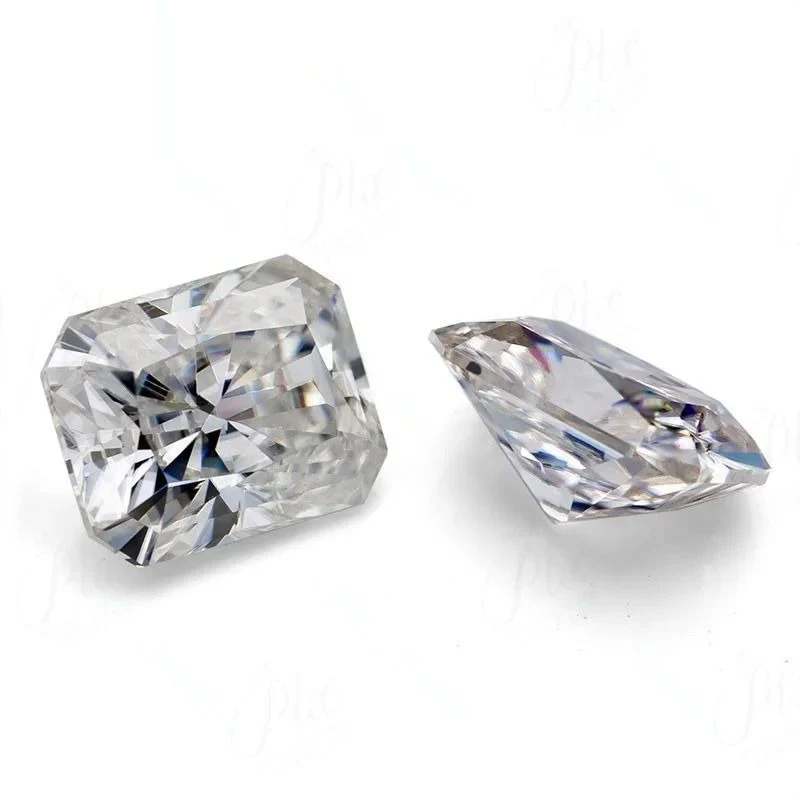
When you shop for moissanite, the first decision after size is usually colour. Sellers offer "colourless" and "near-colorless" stones, sometimes labelled with diamond-style grades D-E-F or G-H-I. The labels promise a difference that may or may not matter on your hand. Here is how the two grades actually compare, and which one you should buy.
How Moissanite Colour Is Graded
Moissanite is not graded the same way diamond is, because it is a single lab-created material with a consistent crystal structure. Sellers borrow diamond-style ranges for convenience. Colourless moissanite corresponds roughly to a diamond D, E or F: no visible body colour when viewed face-up in white light. Near-colorless corresponds roughly to G, H or I: a faint warm or slightly green-grey tint that most people cannot see without a side-by-side comparison. Our broader moissanite colour grades guide covers the history of the tint, including the faintly green cast of older batches.
What You Actually See
Moissanite's high fire means it throws rainbows constantly, which masks a faint body colour. In everyday indoor light, a near-colorless stone looks white. Under bright sunlight or against a sheet of white paper, the warmth or faint green-grey tint becomes visible, especially in larger stones over 1 carat equivalent. A colourless stone removes even that hint. If you want to see the difference, ask the seller for two photographs of the same shape side by side on white paper under daylight.
Metal Changes the Decision
The ring metal does more than the stone's grade in most cases:
- Platinum or white gold: the cool white metal pulls the stone toward white. Near-colorless G-H usually looks white enough. Only if you plan to compare side by side with a real diamond should you step up to colourless.
- Yellow gold: the warm metal warms the stone anyway. Near-colorless is the standard choice; colourless offers almost no visible benefit and costs more.
- Rose gold: pink-gold rings look romantic with a near-colorless stone. Colourless is wasted here.
Price Difference
Colourless moissanite typically costs more than near-colorless, often 15% to 30% more at the same size. The jump is smaller than the equivalent diamond jump, because moissanite is already far cheaper than diamond per carat. Our guide to moissanite pricing puts these numbers in pounds and explains what drives the price gap between grades.
Does Moissanite Change Colour Over Time?
A common worry is that the stone will yellow as it ages. It does not. Moissanite is chemically stable and does not oxidise. Any visible tint change over years is almost always a buildup of soap, lotion and skin oils on the surface, which a clean with warm water and a soft brush removes. If you want the long-term picture, read our does moissanite change colour article.
Which Should You Buy?
If your ring will sit on platinum or white gold, if the stone is over 1.5 carat equivalent, and if you will compare it with diamonds, choose colourless. If your ring is in yellow or rose gold, if the stone is under 1.2 carats, or if you are budget-conscious, near-colorless is the smart buy. The money you save can go into a better cut, a nicer setting or an extra insurance premium.
Cut Matters More Than Colour
Whatever grade you choose, cut quality drives the look. A well-cut near-colorless stone will out-sparkle a poorly cut colourless one. Ask the seller for a video of the stone rotating under light, and check that the moissanite cut and brilliance is a modern hearts-and-arrows or excellent-grade cut rather than an older, duller cut.
How Lighting Changes the Look
Moissanite behaves differently under different lights. Under warm indoor bulbs, near-colorless stones look subtly warmer; under cool daylight or office LEDs, the same stone looks whiter. If you spend most of your time outdoors or in cool-lit offices, the near-colorless grade will read whiter on your hand than it does under a shop's warm display lighting. Ask the seller for daylight and indoor shots before deciding.
Comparing Side by Side
If you are choosing between the two grades, ask the seller to photograph both on the same white paper at the same size under the same light. The difference will be obvious in that controlled setup, even if it vanishes on your finger. If the two photos look nearly identical to you, save the money and go near-colorless. If the warmth jumps out at you, step up to colourless.
Bottom Line
Colourless moissanite is the safe, premium choice for white-metal rings. Near-colorless is the value choice that nearly everyone looks happy with. Buy the grade that matches your metal and your budget, then spend the rest on cut and setting. If you are still unsure, ask the seller for a sample return window so you can see the stone on your own hand in your own light before you commit.
For third-party reference, the Wikipedia article on moissanite details moissanite’s discovery, optical properties and use in jewellery.
Related Reading
- What Is Moissanite Complete Guide to Quality - HOLYCOME
- Moissanite Hardness Durability and Care Guide - HOLYCOME
- What Is Moissanite Complete Guide to Properties Value and Care - HOLYCOME
Frequently Asked Questions
Is moissanite a good diamond alternative for retail buyers?
Yes for price-sensitive customers who want brilliance and hardness. Moissanite ranks 9.25 on the Mohs scale, holds up to daily wear and costs a fraction of a natural diamond of the same size, so it resells fast in bridal and fashion lines.
What is the minimum order for wholesale moissanite?
MOQ starts at 50 pieces per design for stock items. Custom cuts and private-label settings usually start at 100–300 pieces depending on the mold.
Do you provide certificates with moissanite stones?
Yes. Every parcel ships with GRA or IGI documentation listing carat weight, color grade and cut. We recommend passing the certificate to your end customer for trust.
How long does sample and bulk production take?
Samples ship in 3–5 days. Bulk runs take 15–20 days under 500 pieces, and 25–30 days for custom work.


