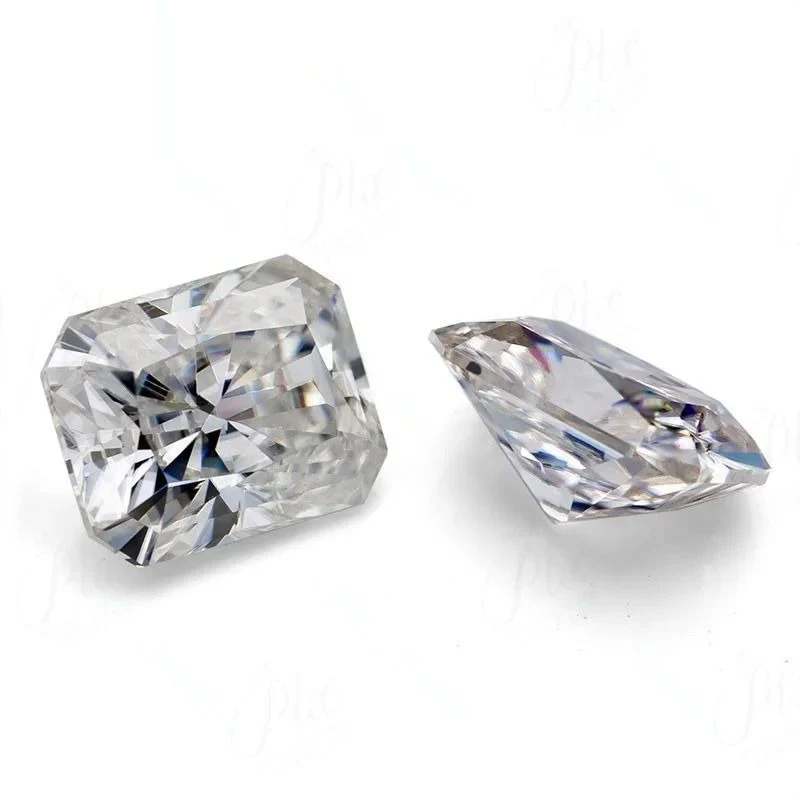
Moissanite listings are full of clarity (per GIA's diamond grading standards) labels — VVS1, VVS2, VS1, VS2 — borrowed directly from the diamond world. If you are new to the stone, it is easy to assume these grades mean the same thing they mean for a mined diamond. They do, roughly, but the context is completely different. Moissanite is grown in controlled chambers rather than dug out of the earth, and that single fact reshapes how much the clarity grade actually matters.
How moissanite is grown, and why it matters for clarity
Gem-quality moissanite is produced in specialised reactors using a heat-based growth process, building up silicon carbide boules over weeks. Because the growth happens in a controlled atmosphere with carefully tuned temperature and gas chemistry, the resulting crystal has far fewer mineral inclusions than a natural diamond formed over billions of years in the earth. There are no trapped garnets, no frozen droplets of mantle rock, no fingerprint clouds from seismic stress. Our guide to how moissanite is grown walks through the process.
What inclusions do appear are usually growth-related: thin internal lines from twinning, small needle-like cavities, or faint feather fractures along a growth boundary. They are structural, not mineral, and they are rare.
It is worth understanding what those growth lines actually look like, because they are the closest thing moissanite has to a diamond-style inclusion. In a rough boule, silicon carbide grows in stacked layers, and when the layers shift slightly during growth, a thin twin line forms inside the crystal. Cut into a faceted stone, that line shows up as a faint internal fracture, often near the girdle. It does not catch light the way a diamond feather does, and it does not present a cleavage risk the way a natural diamond feather might, but it is the feature a grader will note when assigning a slightly lower clarity grade.
The grading scale, applied loosely
Retailers borrow the diamond clarity labels — VVS1, VVS2, VS1, VS2, SI1, SI2 — because shoppers already understand them. In practice, the vast majority of commercial moissanite is VVS or better. You will rarely see a true SI-grade moissanite on a retail listing, and when you do, the inclusion is usually a faint growth line or a slight clouding near the girdle rather than a visible black carbon spot.
Unlike mined diamond, where clarity can swing a stone from eye-clean to noticeable dark speck across a few grades, moissanite clarity differences are subtle. A VVS1 and a VS2 moissanite of the same cut and colour will look nearly identical to the naked eye, and often through a loupe as well.
What to actually buy
For an engagement ring, VVS or VS is the practical sweet spot. You will not see anything with the naked eye, and the stone will read clean from across the room. There is no reason to pay a premium for Flawless moissanite, because the visual difference between Flawless and VVS2 is essentially zero in a mounted ring.
If you are comparing two listings and one advertises IF or Flawless at a much higher price, treat it as marketing rather than a real upgrade. The money is usually better spent on cut quality, which drives moissanite's signature fire and brilliance far more than clarity does. Our guide to moissanite cut and brilliance explains why.
What to watch for instead
Because clarity is naturally high, the quality differences that actually show up in moissanite are colour and clouding. Lower-grade commercial moissanite can look faintly greenish, greyish, or milky, and that clouding is often described (or hidden) under the clarity label. Our guide to moissanite colour grades walks through the colour scale, and our article on checking a moissanite certificate explains what to actually verify on the paperwork.
Clouding is the one clarity-adjacent issue worth caring about. It shows up as a milky or hazy appearance inside the stone, often from growth irregularities rather than classic inclusions. It is most visible in larger stones (2 ct equivalent and up) and in strong direct light. If you are buying online, ask for a real-video clip in daylight, not just a studio render.
Eye-clean is the real standard
For any faceted gem, the practical clarity standard is eye-clean — no inclusions visible to a person with normal eyesight at about 25 cm, without magnification. Because moissanite is already so clean, nearly every commercial stone clears this bar comfortably. You do not need to study the clarity chart the way you would for a mined diamond, where jumping from SI1 to VS2 can mean the difference between a visible speck and a clean look.
What you should do, instead, is focus on cut symmetry and colour. Those two factors dominate how a moissanite looks on the hand, and they are where the cheap-to-premium gap actually shows up.
The bottom line
Moissanite clarity is high by default, which means the VVS label on most listings is a baseline, not a premium. Buy VVS or VS, spend the difference on cut and colour, and inspect the certificate for any note of clouding or growth lines. Treat the clarity grade as a box to tick rather than a dimension to over-optimise.
Related Reading
- What Is Moissanite Complete Guide to Quality - HOLYCOME
- Moissanite Hardness Durability and Care Guide - HOLYCOME
- What Is Moissanite Complete Guide to Properties Value and Care - HOLYCOME
Frequently Asked Questions
Is moissanite a good diamond alternative for retail buyers?
Yes for price-sensitive customers who want brilliance and hardness. Moissanite ranks 9.25 on the Mohs scale, holds up to daily wear and costs a fraction of a natural diamond of the same size, so it resells fast in bridal and fashion lines.
What is the minimum order for wholesale moissanite?
MOQ starts at 50 pieces per design for stock items. Custom cuts and private-label settings usually start at 100–300 pieces depending on the mold.
Do you provide certificates with moissanite stones?
Yes. Every parcel ships with GRA or IGI documentation listing carat weight, color grade and cut. We recommend passing the certificate to your end customer for trust.
How long does sample and bulk production take?
Samples ship in 3–5 days. Bulk runs take 15–20 days under 500 pieces, and 25–30 days for custom work.


