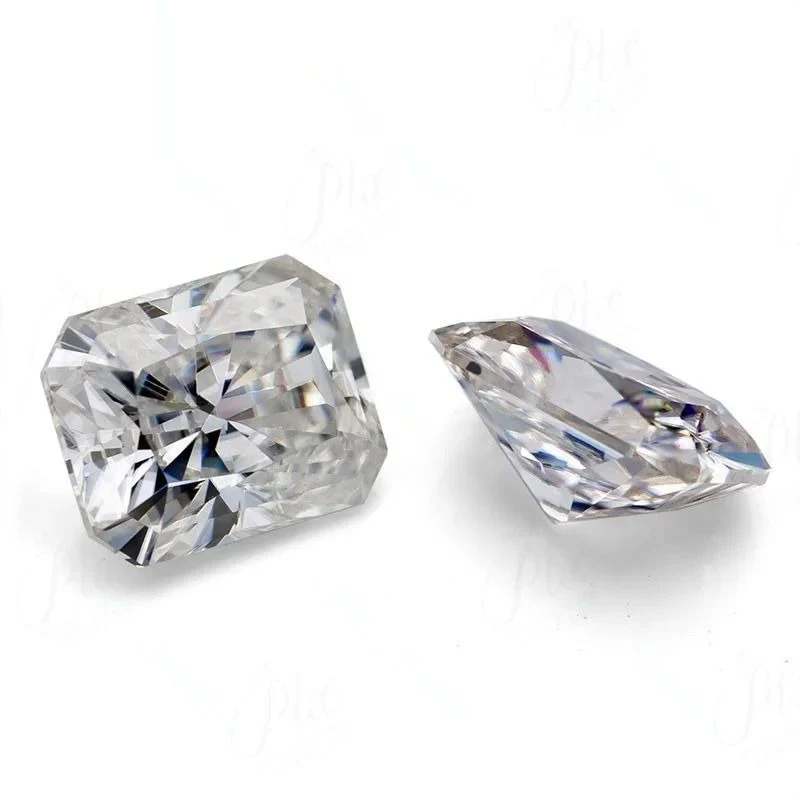
Moissanite sits in the shopper's mind next to diamond, but the two materials could not be made more differently. Diamonds, whether mined or lab grown, are pure carbon crystals. Moissanite is silicon carbide, a compound of silicon and carbon that forms in a completely different way. Understanding that chemistry explains its signature fire, brilliance and double refraction, and why it behaves like nothing else in a jewelry store.
From a meteor crater to the lab
Natural moissanite is extraordinarily rare. It was first identified by the chemist Henri Moissan in 1893, inside rock samples from a meteor crater in Arizona. The tiny crystals he found were never plentiful enough for jewelry, and for decades after his discovery the material existed only as a scientific curiosity. Every moissanite gem you have ever seen was created artificially in a controlled environment, which is also why its supply is consistent and its price is predictable.
Growing the crystal
Modern production grows silicon carbide boules using a high-temperature vapor process. Silicon and carbon source material are loaded into a sealed furnace alongside a small seed crystal. The chamber is heated to extreme temperatures, roughly in the region of 2,000 to 2,500 degrees Celsius, and the source material sublimates into vapor rather than melting. That vapor then condenses onto the cooler seed crystal, layer by layer, over several days. Slowly, a hexagonal, dark, often opaque crystal boule grows. It looks nothing like a finished white gem at this stage; it is more like a dark industrial crystal than a sparkling stone, and a long way from an engagement ring.
Color and clarity of the rough
As-grown silicon carbide commonly carries greenish, yellowish or grayish tones, and the boule may contain internal stress, zoning and inclusions. Producers refine the growth process and use controlled heat treatments to lift the material toward the near-colorless grades shoppers expect. The result is rough that can be cut into faceted gems while keeping the high refractive index near 2.65 and the hardness around 9.25 on the Mohs scale. That combination is unusual: very few gem materials are both that hard and that optically refractive.
Cutting and polishing
Silicon carbide is hard, but it is also brittle, so cutting demands specialized equipment. Polishers use diamond-impregnated tools because almost nothing else will abrade the material, and each stone is shaped by hand and machine rather than stamped out. The cut matters a great deal here: because moissanite refracts and disperses light more strongly than diamond, a well-proportioned cut maximizes brilliance and controls the visible facet doubling that comes from its double refraction. A poorly cut moissanite looks darker or lifeless, which is why cut quality is worth checking on any stone, just as it would be on a diamond.
How this differs from lab-grown diamond
Buyers sometimes assume moissanite and lab-grown diamond are the same kind of product, because both are made in a factory. They are not. Lab-grown diamond is grown as pure carbon using high-pressure high-temperature chambers or chemical vapor deposition, and the result is chemically and optically identical to mined diamond. Moissanite is a different compound entirely, with its own refractive index, its own double refraction and its own dispersion. It is not a substitute being passed off as diamond; it is a separate gem with its own personality, and its price reflects that.
Why the origin matters to a buyer
Knowing moissanite is a manufactured crystal helps you separate it from diamond. It is ethically transparent, predictable in supply, and far kinder to a budget than a comparable-sized diamond. It is grown in days rather than pulled from deep mines, and its durability means it can be worn daily without the anxiety attached to a rare natural stone. That is the whole reason it has become a serious option for engagement rings rather than a footnote in a display case.
Why supply stays controlled
Unlike a mined stone, which is found or not found, a moissanite crystal is grown to order. That means supply is steady, pricing is predictable, and a jeweler can reorder the same grade and shape years later without chasing a single rough parcel. It also means the material is not tied to a remote mine or a fluctuating commodity market, which is part of why it has become a dependable choice for high-volume bridal design. The trade-off is that no two moissanite stones carry the unique geological story that a rare diamond does, but most buyers weigh that against the clarity of cost and ethics they get in return.
A short history
After Moissan's discovery, silicon carbide was studied for its hardness and heat resistance, and it found its way into industrial uses like abrasive powders and semiconductor parts long before it became a gem. Only once producers learned to grow larger, cleaner, near-colorless boules did it become realistic to cut faceted jewelry stones. The moissanite engagement rings worn today are the result of decades of refining that industrial crystal into a gem-grade material, which is why it sits among the most credible diamond alternatives on the market.
For third-party reference, the Wikipedia article on moissanite details moissanite’s discovery, optical properties and use in jewellery.
Related Reading
- What Is Moissanite Complete Guide to Quality - HOLYCOME
- Moissanite Hardness Durability and Care Guide - HOLYCOME
- What Is Moissanite Complete Guide to Properties Value and Care - HOLYCOME
Frequently Asked Questions
Is moissanite a good diamond alternative for retail buyers?
Yes for price-sensitive customers who want brilliance and hardness. Moissanite ranks 9.25 on the Mohs scale, holds up to daily wear and costs a fraction of a natural diamond of the same size, so it resells fast in bridal and fashion lines.
What is the minimum order for wholesale moissanite?
MOQ starts at 50 pieces per design for stock items. Custom cuts and private-label settings usually start at 100–300 pieces depending on the mold.
Do you provide certificates with moissanite stones?
Yes. Every parcel ships with GRA or IGI documentation listing carat weight, color grade and cut. We recommend passing the certificate to your end customer for trust.
How long does sample and bulk production take?
Samples ship in 3–5 days. Bulk runs take 15–20 days under 500 pieces, and 25–30 days for custom work.


