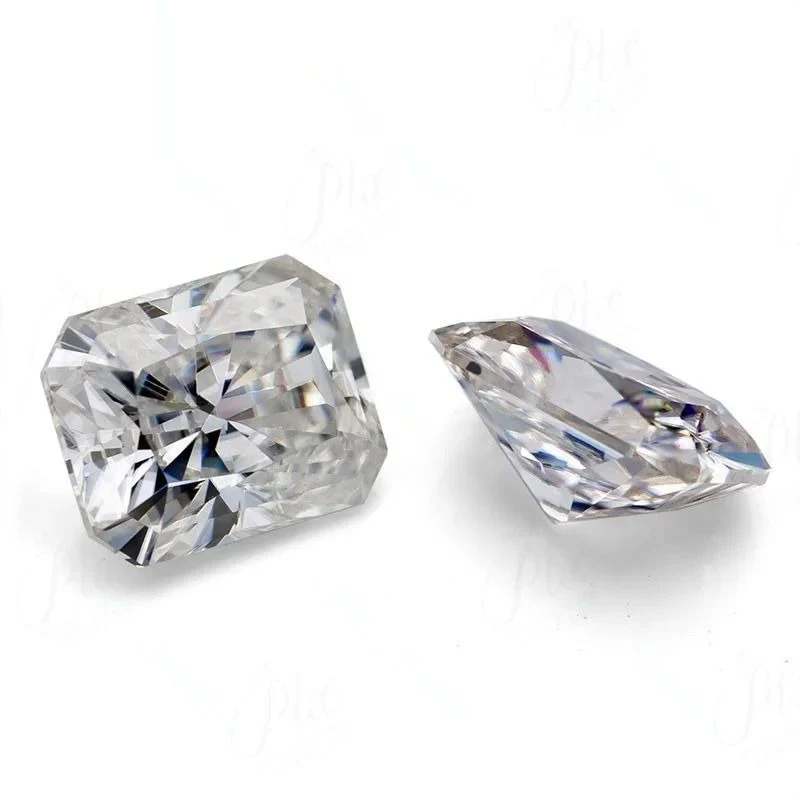
Browsing white gemstones on a budget, you will almost certainly run into white topaz and moissanite sitting near each other in search results. Both can be cut to look colorless and bright, both cost a fraction of a diamond, and both show up in inexpensive engagement rings. But if you plan to wear the stone every day, the comparison is not close. The difference comes down to hardness, how the stone cuts light, and what happens after a year of hand-washing, knocks, and contact with household chemicals.
The basics of each stone
White topaz is a colorless variety of topaz, a mineral that occurs naturally and is often irradiated or heat-treated to improve clarity and tone. It is popular in affordable jewelry because it is readily available and can be cut into large, clean stones. Moissanite is silicon carbide, produced in controlled environments because natural moissanite is too rare to use in jewelry. It is engineered specifically to mimic diamond-like performance, which changes the whole durability conversation.
Hardness: the deal-breaker for daily wear
On the Mohs scale, white topaz sits around 8, which sounds decent until you compare it with moissanite at roughly 9.25. More importantly, topaz has perfect basal cleavage, meaning it can split along clean planes if struck at the right angle. In real wear, topaz edges go dull and abraded within months of daily use—the facet edges that create sparkle wear away first, and the stone starts to look hazy and glassy. Moissanite resists scratching almost as well as diamond and holds its polish for years. Our piece on moissanite durability explains the long-term wear in detail.
How they look
Both stones are bright, but they light up differently. Moissanite has a higher refractive index and strong fire, so it throws vivid rainbow flashes and keeps a lively sparkle even in mediocre light. White topaz is lighter on fire and lower on brilliance; it can look frosty or washed out once the facets wear. A fresh, perfectly cut white topaz can look attractive in a display case, but that early beauty fades faster than most buyers expect. For context on what drives the sparkle, see moissanite fire and brilliance.
Price and where each makes sense
White topaz is dramatically cheaper—often a fraction of the cost of a comparable moissanite. That low price makes it reasonable for occasional pieces: cocktail rings, pendants, or costume-style jewelry you wear a few times a year. It is a poor choice for an everyday engagement ring or a wedding band you never take off, because the daily wear will erode its appearance quickly. Moissanite costs more upfront but is built for the hand, and its price per carat-equivalent still leaves it far cheaper than diamond.
The bottom line
How the price gap actually looks over time
Walk a jeweler's showcase and the cost difference is stark. A large white topaz solitaire can sell for less than a small moissanite ring, which is tempting when a budget is tight. The trap is replacement cost. A topaz ring that dulls in a year has to be replaced, while a moissanite bought at two or three times the price still looks new after five. Spread across a decade, the cheaper stone often costs more in total because it never really lasts. This is the same logic that makes moissanite pricing compare well against cheap simulants over the long run.
Topaz does have one legitimate use beyond occasional wear: it is often sold as a birthstone and in colorful, treated hues like Swiss blue. As a colored stone in a pendant or earrings worn rarely, topaz is perfectly reasonable. The problem is specifically choosing it as the daily center of an engagement ring. If you love the look of a bright white stone but want it to survive handwashing, typing, and gym sessions, the step up to moissanite is worth it, and the gap is still small next to any diamond. When in doubt, hold both stones side by side in the same light. The moissanite will show livelier, more consistent sparkle, while the topaz looks softer and already slightly flat even when new.
If you want a white stone for occasional wear and the lowest possible price, white topaz is a light, pretty option. If you want a colorless, brilliant stone that survives daily life, keeps its edge, and stays bright for years, moissanite is the sensible pick. Buying a white topaz for a forever ring is the classic mismatch: cheap today, dull next year, and a replacement you did not plan for. Choose the stone that matches how you actually wear jewelry, not just how it looks in the photo. A white stone that stays bright on a daily hand is worth more than a cheap one that has to be hidden away on special occasions.
For third-party reference, the Wikipedia article on moissanite details moissanite’s discovery, optical properties and use in jewellery.
Related Reading
- What Is Moissanite Complete Guide to Quality - HOLYCOME
- Moissanite Hardness Durability and Care Guide - HOLYCOME
- What Is Moissanite Complete Guide to Properties Value and Care - HOLYCOME
Frequently Asked Questions
Is moissanite a good diamond alternative for retail buyers?
Yes for price-sensitive customers who want brilliance and hardness. Moissanite ranks 9.25 on the Mohs scale, holds up to daily wear and costs a fraction of a natural diamond of the same size, so it resells fast in bridal and fashion lines.
What is the minimum order for wholesale moissanite?
MOQ starts at 50 pieces per design for stock items. Custom cuts and private-label settings usually start at 100–300 pieces depending on the mold.
Do you provide certificates with moissanite stones?
Yes. Every parcel ships with GRA or IGI documentation listing carat weight, color grade and cut. We recommend passing the certificate to your end customer for trust.
How long does sample and bulk production take?
Samples ship in 3–5 days. Bulk runs take 15–20 days under 500 pieces, and 25–30 days for custom work.


