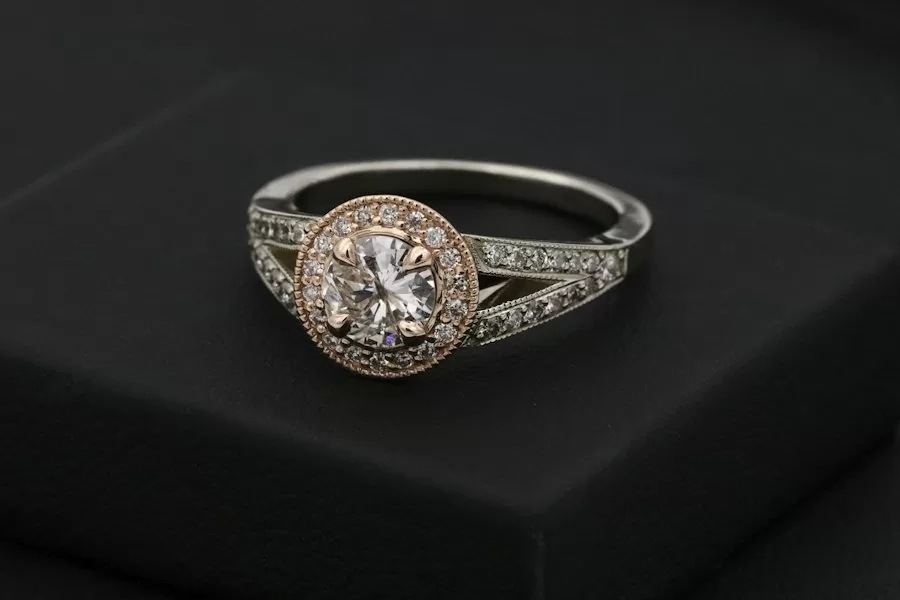
Moissanite brings a different optical personality to a ring than a mined diamond. Its refractive index sits around 2.65, noticeably higher than diamond's 2.42, which means it bends light more sharply and throws more coloured fire. Pair it with the right setting and that fire looks intentional; pair it with the wrong setting and the stone can look closed-up, dark, or busy. Here is how to choose.
Solitaire prong settings: the classic
A four- or six-prong solitaire lets the most light in from every angle, which is exactly what a moissanite wants. With RI around 2.65, more open sky around the crown means more dispersion and more rainbow flashes. Six prongs offer a touch more security for a stone rated 9.25 on the Mohs scale, while four prongs keep the outline clean. A high cathedral or raised head also lets light leak in from underneath, boosting brightness. If you want to see how settings compare more broadly, start with our setting styles explainer.
Bezel settings: secure, but careful
A full bezel cups the stone in metal and protects the girdle, which is lovely for an active wearer. But a bezel also blocks light entering from the side, and on a high-RI gem like moissanite that can visibly reduce the fire. If you love the bezel look, ask for a partial or half-bezel, or a bezel with an open gallery. You keep most of the protection without dimming the stone.
Halo settings: amplifier mode
A halo of smaller stones around the centre makes any gem look larger and brighter, and it works particularly well for moissanite. The surrounding stones bounce light back into the centre crown, which plays up the dispersion. A double halo pushes the effect further, but watch proportions: on a smaller centre stone, a wide halo can make the ring look top-heavy. Many couples pair a moissanite centre with lab-grown diamond side stones, which is covered in matching moissanite wedding bands.
Pavé and channel shoulders
Pavé-set shoulder stones add sparkle along the band without competing with the centre. Channel settings are smoother and lower-profile, but they can feel slightly dated on an otherwise modern moissanite. Either works; just match the metal finish to the wearer's taste.
Shape matters more than you think
Oval and pear moissanite look best in settings that protect their tips, because the points of fancy shapes take the most wear. A V-prong on each tip is worth the small extra cost. Emerald-cut moissanite, with its open step facets, reads beautifully in a clean solitaire because the long lines show off the double refraction without too much noise. If you are still deciding on shape, our shape comparison applies equally well to moissanite.
Metal choices for moissanite
White gold and platinum set off a colourless moissanite crisply. Yellow gold softens the look and hides any faint warmth in lower-grade stones, which is helpful because moissanite's upper grades can read slightly grey without a white-metal surround. Rose gold pairs well with warmer moissanite grades for a vintage feel. Whatever you pick, remember that moissanite's durability (9.25 on Mohs) means you can choose a slightly daintier setting than you might for a softer gem, but prongs still need a regular check.
Avoid these mistakes
Skip thick, closed-back settings that trap moisture behind the stone. Skip deep "illusion" settings that crowd the crown. And skip settings designed for a diamond's proportions without asking the maker to verify the moissanite dimensions; moissanite is often cut slightly thicker at the girdle than a diamond of the same carat equivalent. When in doubt, ask the jeweller to set a loose moissanite in the proposed head before you commit, so you can see the final look on your hand.
Head height and daily wear
Think about how high the head sits off the finger. A high head lets light in from underneath, which boosts both brightness and fire, but it also catches on sweaters, gloves, and car steering wheels. A low, tucked-under head is smoother for people who work with their hands, but it dims the stone slightly. Most couples land somewhere in the middle, with a head that sits just high enough to sparkle and just low enough to avoid catching on fabrics.
Side stone pairing
If you add side stones, choose them to complement the moissanite rather than compete. Smaller moissanite side stones keep the look affordable and consistent, while lab-grown diamond side stones add a crisp white contrast that makes the centre pop. Avoid pairing a high-fire moissanite centre with heavily included diamond side stones, because the contrast in clarity will draw the eye away from the centre instead of toward it. Whatever you choose, ask the maker to show you a CAD or a wax model before the ring is cast, so you can check the proportions on screen before the metal is poured.
For third-party reference, the Wikipedia article on moissanite details moissanite’s discovery, optical properties and use in jewellery.
Related Reading
- What Is Moissanite Complete Guide to Quality - HOLYCOME
- Moissanite Hardness Durability and Care Guide - HOLYCOME
- What Is Moissanite Complete Guide to Properties Value and Care - HOLYCOME
Frequently Asked Questions
Is moissanite a good diamond alternative for retail buyers?
Yes for price-sensitive customers who want brilliance and hardness. Moissanite ranks 9.25 on the Mohs scale, holds up to daily wear and costs a fraction of a natural diamond of the same size, so it resells fast in bridal and fashion lines.
What is the minimum order for wholesale moissanite?
MOQ starts at 50 pieces per design for stock items. Custom cuts and private-label settings usually start at 100–300 pieces depending on the mold.
Do you provide certificates with moissanite stones?
Yes. Every parcel ships with GRA or IGI documentation listing carat weight, color grade and cut. We recommend passing the certificate to your end customer for trust.
How long does sample and bulk production take?
Samples ship in 3–5 days. Bulk runs take 15–20 days under 500 pieces, and 25–30 days for custom work.


