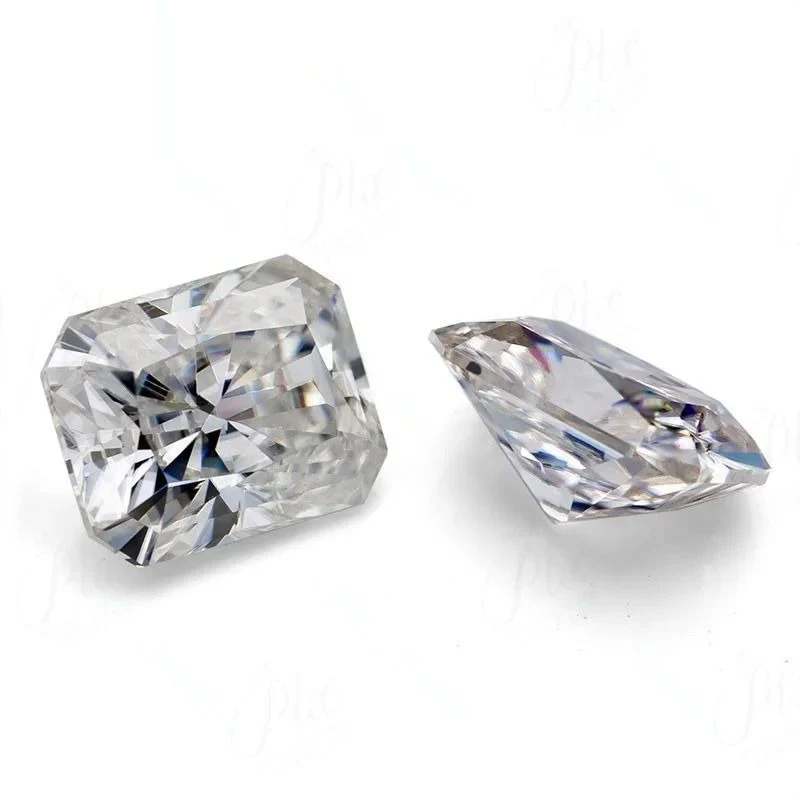
Stud earrings are one of the easiest ways to wear moissanite. A pair of 6mm studs gives the look of roughly a 1-carat-total pair for a fraction of a diamond equivalent, and moissanite's hardness handles the knocks that earring posts take. Before you buy, a few practical choices separate a great pair from an annoying one.
Sizing moissanite studs
Moissanite is sold by millimetre rather than carat weight, which is useful for earrings because you are matching two stones by eye. Common stud sizes are 4mm, 5mm, 6.5mm and 8mm. A 6.5mm round is the everyday sweet spot: visible enough to read as "diamond", small enough to wear to the office. Our moissanite carat vs mm chart converts the sizes into diamond equivalents if you are comparing quotes.
Because moissanite throws strong fire, a slightly smaller stone often looks better than an oversized one. Very large studs catch more light and the rainbow flashes can look busy on a moving ear. If you wear your hair down, a slightly smaller size also stops the stone disappearing behind it.
Posts and metal matter more than the stone
Earring posts sit against skin and inside a fresh or half-healed piercing, so the post material is where reactions happen. Nickel in cheap posts is the usual culprit. Choose solid 14k gold, 18k gold, platinum or a titanium post. If you have sensitive ears, the post should be the same metal as the setting, not a plated steel wire. This is the same principle as our nickel-free engagement ring metal advice, applied to ears.
Backs: push vs screw
The back is what keeps the earring on your ear. Push backs (friction backs) are easy on and off but can work loose in sleep or sport. Screw backs (the back twists onto a threaded post) are far more secure, which is the right choice for any pair you would be upset to lose. Locking backs, with a small hinged clip, sit between the two in security and comfort. For studs you wear daily, screw backs are worth the extra few seconds.
Weight and long-wear comfort
Even a small stone has some weight, and a heavier stud will gradually stretch the piercing hole over years of daily wear. Larger 8mm studs are best reserved for occasional wear rather than all-day, every-day use. If you want a big look but a light feel, look for a hollow or open-back setting rather than a solid closed basket, which adds weight without adding sparkle.
Durability in ears
Moissanite scores around 9.25 on the Mohs scale, which is more than hard enough for earrings that bump against hairbrushes and phone receivers. It is not indestructible, but it is close to the toughness you need. Our moissanite durability guide covers the limits, including the heat-sensitivity note worth knowing before you use ultrasonic cleaners on them.
Cleaning stud earrings
Studs collect oils and earwax faster than rings, because the post sits against skin. Clean them weekly with warm soapy water and a soft brush, taking care around the joint between post and basket. The full routine is in moissanite cleaning and care. Worn posts can also be replaced by a jeweller if the clutch begins to grip loosely.
Caring for new piercings
If you are buying studs for a fresh or healing piercing, the stone matters less than the post. Stick to solid gold, titanium or platinum, keep the area clean, and avoid changing the back until the piercer says it is healed. Moissanite itself is inert and will not tarnish or react, so once the piercing is settled the studs are low-maintenance. For ongoing upkeep, our moissanite cleaning and care routine applies as much to earrings as to rings.
Studs vs other moissanite earring styles
Studs are the most practical entry point, but huggie hoops, drops and ear climbers all work well in moissanite. Hoops and drops move more, so their stones need secure settings; a bezel or a four-prong basket is safer than a single claw on a swinging piece. If you want one pair you never have to think about, start with screw-back studs in a 6 to 6.5mm stone and build from there.
Diamond studs vs moissanite studs
Moissanite studs will look brighter and more colourful than a similar-sized diamond pair, especially in indoor light. If that reads as "diamond-like" to you, the saving is substantial. If you prefer the quieter, whiter flash of diamond, the same optical difference works against you. Try both in natural light before you decide, and remember the post metal choice matters either way.
Buy the back type first and the stone size second. A screw-back in 6mm on a solid post will serve you for years; a friction-back in 8mm on a plated post will either loosen, react, or both. Comfort and security decide whether a pair of earrings stays in your rotation.
EU-wide limits on nickel, lead and cadmium in jewellery are set by the REACH Regulation (EC) No 1907/2006 on EUR-Lex.
Related Reading
- What Is Moissanite Complete Guide to Quality - HOLYCOME
- Moissanite Hardness Durability and Care Guide - HOLYCOME
- What Is Moissanite Complete Guide to Properties Value and Care - HOLYCOME
Frequently Asked Questions
Is moissanite a good diamond alternative for retail buyers?
Yes for price-sensitive customers who want brilliance and hardness. Moissanite ranks 9.25 on the Mohs scale, holds up to daily wear and costs a fraction of a natural diamond of the same size, so it resells fast in bridal and fashion lines.
What is the minimum order for wholesale moissanite?
MOQ starts at 50 pieces per design for stock items. Custom cuts and private-label settings usually start at 100–300 pieces depending on the mold.
Do you provide certificates with moissanite stones?
Yes. Every parcel ships with GRA or IGI documentation listing carat weight, color grade and cut. We recommend passing the certificate to your end customer for trust.
How long does sample and bulk production take?
Samples ship in 3–5 days. Bulk runs take 15–20 days under 500 pieces, and 25–30 days for custom work.


