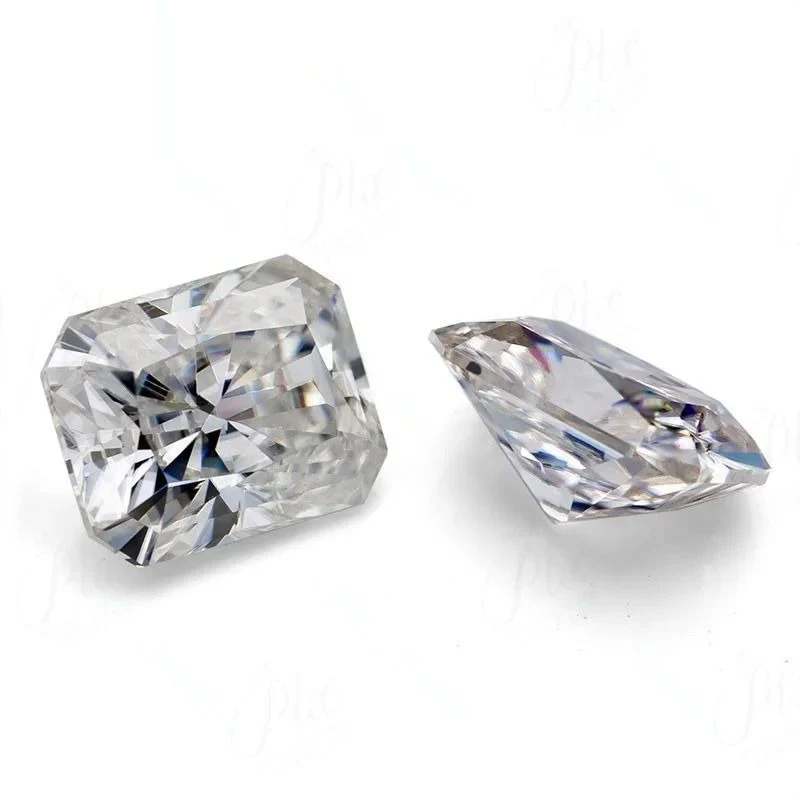
If someone has ever described moissanite as "too fiery" or "rainbowy", they are reacting to its optical properties. Moissanite is not a diamond substitute chosen for looks by accident; it has genuinely different numbers for refractive index and dispersion, and those numbers produce the flashes people notice. Understanding them explains both the praise and the criticism.
Refractive index: how much light bends
The refractive index (RI) measures how strongly a material bends light as it enters. Higher RI means light bounces around inside the stone more before escaping, which usually translates into more brilliance. Diamond sits at about 2.417. Moissanite is higher, around 2.65 to 2.69, which is why a well-cut moissanite can look exceptionally bright face-up.
A higher RI also means moissanite can hold a sharp, reflective facet edge at proportions where a diamond of the same cut would look dull. This is part of why moissanite reads as lively even at smaller sizes, and why a 6mm moissanite often looks brighter than a similar-sized white sapphire.
Dispersion: the fire
Dispersion measures how much white light splits into colours as it passes through the stone. It is the technical word for "fire". Diamond's dispersion is about 0.044. Moissanite's dispersion is roughly 0.104, more than double diamond's.
That is the whole reason moissanite flashes obvious rainbow colours in bright light. Move a moissanite ring under a spotlamp and you will see orange, blue and violet pulses that a diamond does not produce at the same strength. Some people love this; others find it too theatrical. Our moissanite fire and brilliance guide shows what it looks like in real lighting.
Daylight vs indoor light
The dispersion reads very differently depending on where you view the ring. In bright daylight or direct sunlight, the fire can look busy and almost over-saturated, because there is so much white light entering the stone. Under softer indoor or overcast light, the same flashes calm down and the brilliance leads. This is why moissanite buyers are often told to view a ring in several light conditions before deciding, rather than judging it under a single shop spotlight. Our note on whether moissanite looks fake covers the same real-world reaction.
Double refraction, briefly
Moissanite is also doubly refractive, meaning light splits into two beams inside the stone. Under magnification this shows up as slightly doubled facet edges, which is the giveaway gemologists use to tell moissanite from diamond. It is covered in detail in moissanite double refraction, so we won't repeat it here, but it is part of the same optical family as the high RI.
Does cut quality change dispersion?
The dispersion number itself is fixed by the material, but how obviously it reads depends on the cut. A poorly proportioned moissanite can look dark or glassy despite high dispersion, because light leaks out before it splits into colour. A well-cut stone directs that light back to the eye as clean flashes. This is why the moissanite cut and brilliance conversation matters even though the material numbers are fixed.
What this means when you shop
The numbers explain two common buying behaviours. First, why moissanite at a small size still looks bright: the high RI keeps brilliance up even when the stone is modest. Second, why some buyers prefer slightly cooler-coloured moissanite: a near-colourless body colour lets the dispersion read as clean rainbow fire rather than muddying it with a warm tint. Our moissanite colour grades guide walks through that trade-off.
If you are comparing the two stones holistically, the optical numbers are only one input; hardness, price and long-term care matter too. See moissanite vs diamond for the full comparison.
Why two moissanites can look different
If dispersion and refractive index are fixed by the material, why does one moissanite look noticeably brighter than another of the same size? The answer is cut and colour grade. A stone cut to loose proportions leaks light, and a warmly tinted body colour can mute the fire, which is why the same gemology numbers produce noticeably different rings in practice. Pairing a cool colour grade with a well-proportioned cut is the closest you get to a predictable result. Our moissanite cut and brilliance guide covers how the cut is chosen.
The bottom line
Moissanite's refractive index and dispersion are not flaws. They are the reason the stone looks the way it does. If you want the quieter, whiter flash of diamond, choose a diamond. If you enjoy obvious fire at a fraction of the price, the same numbers are a feature. Knowing the difference lets you pick on purpose rather than by surprise.
None of these numbers need to be memorised. What matters is that you go into the purchase knowing moissanite will read brighter and more colourful than a diamond of the same size, and that this is a deliberate property of the stone rather than a quality problem.
Independent background on moissanite — how its hardness and refractive index compare with diamond — is documented in the Wikipedia article on moissanite.
Related Reading
- What Is Moissanite Complete Guide to Quality - HOLYCOME
- Moissanite Hardness Durability and Care Guide - HOLYCOME
- What Is Moissanite Complete Guide to Properties Value and Care - HOLYCOME
Frequently Asked Questions
Is moissanite a good diamond alternative for retail buyers?
Yes for price-sensitive customers who want brilliance and hardness. Moissanite ranks 9.25 on the Mohs scale, holds up to daily wear and costs a fraction of a natural diamond of the same size, so it resells fast in bridal and fashion lines.
What is the minimum order for wholesale moissanite?
MOQ starts at 50 pieces per design for stock items. Custom cuts and private-label settings usually start at 100–300 pieces depending on the mold.
Do you provide certificates with moissanite stones?
Yes. Every parcel ships with GRA or IGI documentation listing carat weight, color grade and cut. We recommend passing the certificate to your end customer for trust.
How long does sample and bulk production take?
Samples ship in 3–5 days. Bulk runs take 15–20 days under 500 pieces, and 25–30 days for custom work.


