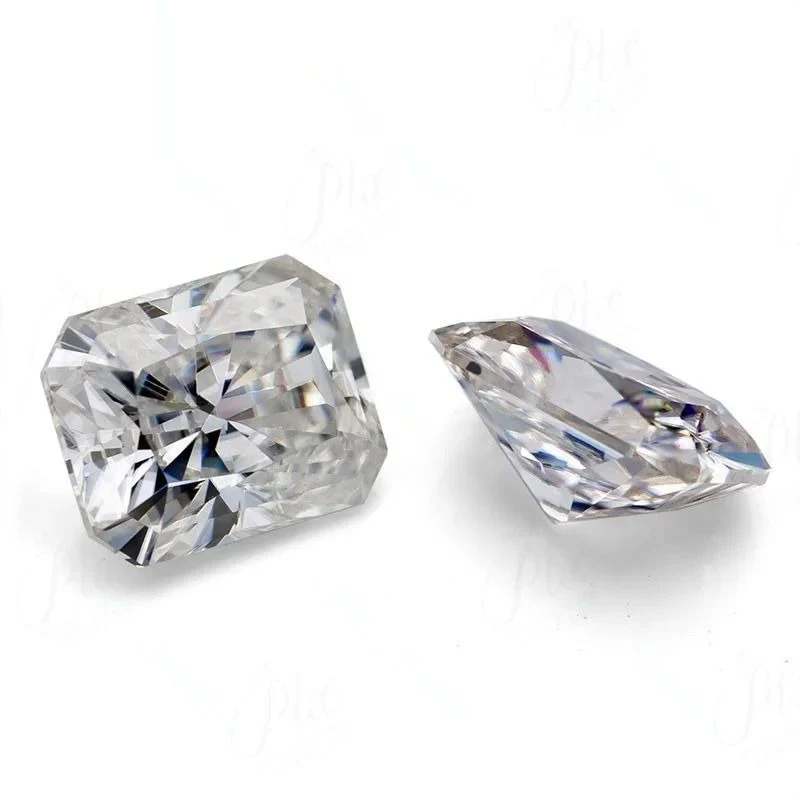
moissanite (per Wikipedia) is one of the newest gem names on a ring, and one of the oldest substances on Earth. Its story does not begin in a jewellery workshop. It begins in a meteor crater in the Arizona desert, and with a French chemist who was actually trying to make diamonds.
Henri Moissan the chemist
Henri Moissan was a Parisian chemist born in 1852. He built his reputation on high-temperature chemistry, developing an electric arc furnace that could reach temperatures no one had worked with before. In 1906 he won the Nobel Prize in Chemistry for his work on fluorine, which he had isolated after years of dangerous experiments. He was, by any measure, a serious scientist, not a gem enthusiast.
The Diablo Canyon meteorite
In 1893, Moissan examined samples from the Diablo Canyon meteorite crater in Arizona, the famous hole carved by an iron meteorite roughly fifty thousand years earlier. Buried in the meteorite debris, he found tiny, transparent crystals that did not match any mineral he could identify. Under the microscope they looked like diamond, but their chemistry did not fit. After careful analysis, Moissan concluded the crystals were silicon carbide, a compound of silicon and carbon that had never been described in nature.
The early debate
For years after, other scientists argued that Moissan had contaminated his own samples with silicon carbide from his lab equipment, which he did use regularly. The debate lasted decades. It was not until the 1950s, when better electron microscopy became available, that natural silicon carbide was confirmed in meteorite samples and the mineral was officially named moissanite in his honour. Tiny natural moissanite has since been found in a handful of other locations, including some upper-mantle rock from Earth's interior, but natural crystals large enough to facet remain extraordinarily rare.
Laboratory synthesis
Silicon carbide was synthesised in the lab well before it was accepted as a natural mineral. Edward Acheson, an American chemist, produced the compound accidentally in 1891 while trying to make diamonds, and he named it carborundum. By the early twentieth century, silicon carbide was being manufactured in bulk as an abrasive. It is extremely hard, heat-resistant, and chemically inert, which made it perfect for grinding wheels, cutting tools, and later semiconductor wafers.
Silicon carbide in industry
For most of the twentieth century, silicon carbide lived in factories, not jewellery shops. It coated sandpaper, lined brake discs, and eventually, with the rise of LED lighting and electric vehicles, became a critical semiconductor material. The silicon carbide used in a modern EV powertrain is chemically the same compound that Moissan found in the meteorite. The gem on a ring and the chip in a car are cousins.
Arrival in jewellery
The move into jewellery came in the late 1990s, when researchers at a company called Cree developed a way to grow large, high-purity silicon carbide crystals using a modified growth process. Those crystals were transparent, brilliant, and hard. The first commercial moissanite engagement stones launched in 1998 under a trademarked name. The market reaction was fast: a diamond-like stone with more fire, at a fraction of the price, was an immediate hit. By the 2010s, moissanite was a standard option on most online engagement ring sites.
Why it carries his name
The mineral name moissanite was formally adopted in 1905, in honour of Henri Moissan, who died in 1907 at only fifty-five. He never saw his name on a ring. He never saw the gemstone industry built on the material he identified. He was a chemist who found something strange inside a rock from space, described it honestly, and moved on.
Today
Modern moissanite is grown in controlled laboratories, not mined from meteorites. The stones in rings today are typically one or two centimetres across, vastly larger than anything Moissan ever saw. But when you look through the pavilion of a moissanite and see the doubled facets, or notice the strong coloured fire that separates it from a diamond, you are looking at the same compound he examined under a microscope in Paris more than a century ago. For a closer look at how the stones are grown today, our piece on how moissanite is made picks up the story where Moissan left off.
Why the origin story matters for buyers
Knowing the history changes how you read the marketing. Moissanite is not a plastic or a cheap knock-off; it is a real crystalline mineral with a Nobel Prize behind its discovery, grown in a factory using decades of materials science. It is also not a diamond substitute in the sense of a fake; it is a different gem with its own chemistry, its own look, and its own durability profile. When a seller tells you the stone is "lab-grown moissanite, the same compound found in meteorites," that is actually true. The history is part of why the material has the reputation it does.
Related Reading
- What Is Moissanite Complete Guide to Quality - HOLYCOME
- Moissanite Hardness Durability and Care Guide - HOLYCOME
- What Is Moissanite Complete Guide to Properties Value and Care - HOLYCOME
Frequently Asked Questions
Is moissanite a good diamond alternative for retail buyers?
Yes for price-sensitive customers who want brilliance and hardness. Moissanite ranks 9.25 on the Mohs scale, holds up to daily wear and costs a fraction of a natural diamond of the same size, so it resells fast in bridal and fashion lines.
What is the minimum order for wholesale moissanite?
MOQ starts at 50 pieces per design for stock items. Custom cuts and private-label settings usually start at 100–300 pieces depending on the mold.
Do you provide certificates with moissanite stones?
Yes. Every parcel ships with GRA or IGI documentation listing carat weight, color grade and cut. We recommend passing the certificate to your end customer for trust.
How long does sample and bulk production take?
Samples ship in 3–5 days. Bulk runs take 15–20 days under 500 pieces, and 25–30 days for custom work.


