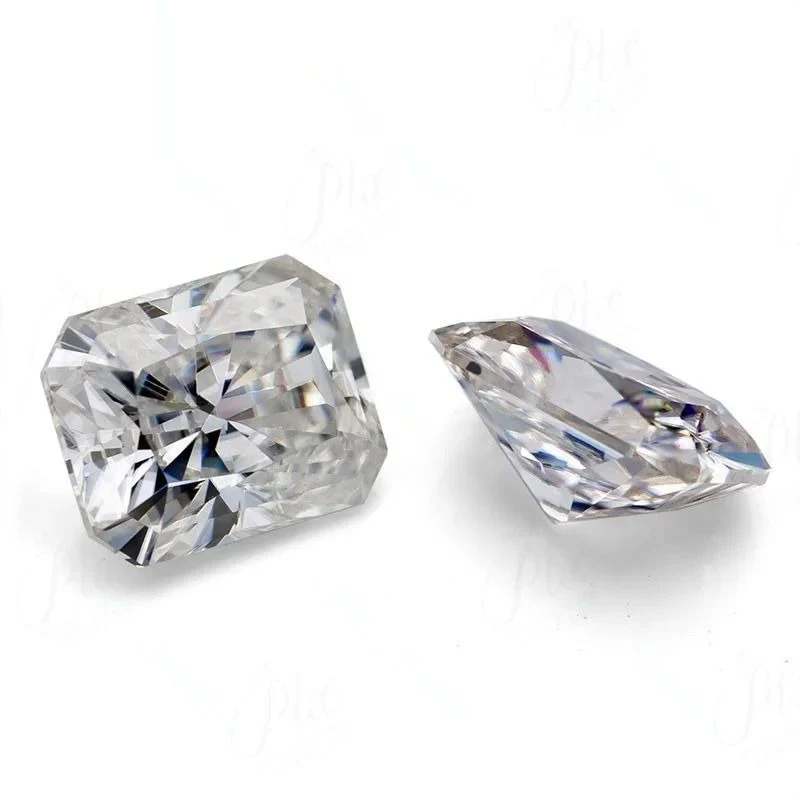
If you have spent time reading about diamond clarity (per GIA's diamond grading standards), the terminology is familiar: FL, IF, VVS1, VS2, SI1, I1. Pick up a moissanite listing and you will rarely see those grades. Instead, sellers talk about "eye-clean" stones, "VVS-equivalent" clarity, or simply show you a photo and say there is nothing to see. The mismatch confuses first-time buyers, and it is worth understanding why moissanite clarity is described differently and what you should actually look for.
Why moissanite is not graded on the diamond scale
Diamond clarity grading was built for natural stones, where inclusions form inside the crystal as it grows deep in the earth. Moissanite is grown in a reactor, and the manufacturing process is controlled tightly enough that most commercial stones have very few internal features to begin with. Independent grading labs such as GIA do not routinely grade laboratory-grown moissanite on the diamond clarity scale, because the inclusions that drive diamond grades simply are not there in the same way. A mass-produced 1ct moissanite is, almost by default, cleaner than a comparable SI diamond.
What inclusions do appear
That does not mean every moissanite is flawless. During growth and cutting, moissanite can develop small cloud-like veils, tiny growth lines, chip marks on the girdle, or faint feather fractures. Some lower-cost stones also carry polishing marks or surface scratches introduced during the cutting process. These features are usually microscopic. In a commercial-grade stone, you will not see them with the naked eye at normal viewing distance. In a budget stone, you might spot a faint cloudy patch under direct light, especially in larger sizes above 8mm.
"Eye-clean" explained
Because formal clarity grades are rarely assigned, the practical standard is "eye-clean". A stone is eye-clean if, when viewed with the naked eye at roughly 25 centimetres under normal lighting, no inclusion is visible. The definition sounds simple, but it has a hidden trap: two different sellers may disagree on what "normal lighting" means. A stone that looks eye-clean under a soft shop light may show a small dark speck when held up to a window. The most reliable way to check is to request close-up macro photos from the seller, taken in natural daylight, and ask specifically whether any inclusion is visible without magnification.
Does higher clarity cost more?
Within moissanite, the price difference between a "VVS" and an "eye-clean" stone is usually small compared with the equivalent gap in diamonds. That is because most production already sits at the clean end of the scale. Where you do see price variation is in colour grade and cut quality, not inclusions. If a seller is charging a significant premium for a "flawless" moissanite, it is worth asking what testing backs that claim, since no major lab routinely issues such a grade for this material. For context, our guide to diamond clarity grading shows how wide the natural-stone range is — and how narrow the moissanite range really is.
The role of cut in hiding inclusions
Even when a moissanite contains a small inclusion, the cut can hide it extremely effectively. In a round brilliant, inclusions placed near the girdle or beneath the crown facets are masked by light return. In fancy shapes such as emerald or Asscher cuts, the step facets show the centre of the stone much more clearly, so an inclusion that would be invisible in a round cut may become obvious. If you are choosing an open, step-cut shape, ask the seller to point out exactly where any inclusions sit. Our guide to moissanite cut and brilliance explains how facet design changes what you see.
Buying a certified stone
Some moissanite suppliers issue their own certificates, noting growth method, dimensions, colour grade and any visible inclusions. These are not third-party diamond-lab reports, but they are useful as a paper trail. Always match the carat, measurement and clarity notes on the certificate to the stone you receive. Our checklist for checking a moissanite certificate walks through what to compare when the parcel arrives.
How clarity compares to colour
Because clarity in moissanite is nearly always excellent, the trade-offs buyers actually make are between colour and cut rather than between clarity grades. A stone marketed as "colorless" will read whiter in daylight, while a "near-colorless" stone may carry a faint warm tint under indoor lighting. If you are comparing two stones on a listing and the only difference is a "VVS" versus "eye-clean" label, you are looking at a marketing distinction rather than a meaningful quality gap. Spend your budget on the colour grade and shape that flatter you, and treat the clarity label as confirmation that nothing obvious is inside the stone. For a deeper dive on the other variable, read our guide to moissanite colour grades.
A practical clarity checklist
When shopping, ask for daylight macro photos, confirm the stone is eye-clean at arm's length, check the girdle for chips, and look at the culet under magnification if possible. Because the clarity range is so narrow, you rarely need to pay a premium for the "best" grade. Spend that budget instead on a well-cut shape you love and a colour grade that suits your skin tone. Treat clarity as a box to tick, not a variable to optimise.
Related Reading
- What Is Moissanite Complete Guide to Quality - HOLYCOME
- Moissanite Hardness Durability and Care Guide - HOLYCOME
- What Is Moissanite Complete Guide to Properties Value and Care - HOLYCOME
Frequently Asked Questions
Is moissanite a good diamond alternative for retail buyers?
Yes for price-sensitive customers who want brilliance and hardness. Moissanite ranks 9.25 on the Mohs scale, holds up to daily wear and costs a fraction of a natural diamond of the same size, so it resells fast in bridal and fashion lines.
What is the minimum order for wholesale moissanite?
MOQ starts at 50 pieces per design for stock items. Custom cuts and private-label settings usually start at 100–300 pieces depending on the mold.
Do you provide certificates with moissanite stones?
Yes. Every parcel ships with GRA or IGI documentation listing carat weight, color grade and cut. We recommend passing the certificate to your end customer for trust.
How long does sample and bulk production take?
Samples ship in 3–5 days. Bulk runs take 15–20 days under 500 pieces, and 25–30 days for custom work.


