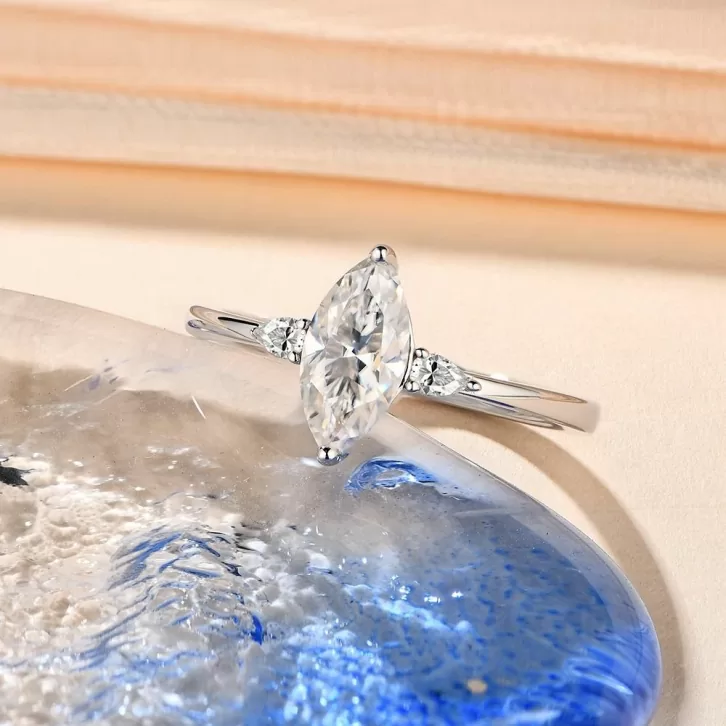
Buying moissanite in person gives you a luxury that online buyers do not have: you can hold the stone under a jeweller's loupe and check the details that matter. A lot of buyers look at a ring, admire the sparkle, and say yes. A ten-minute inspection catches the problems that would otherwise show up six months later — a chipped culet, a loose prong, a greenish tint in daylight, or a poorly matched pair of side stones.
The ten-point inspection
1. Look at the colour in daylight. Step outside or stand by a window. Moissanite can show a slightly greenish or yellowish tint that is hidden under warm shop lighting. If the tint bothers you next to white gold or platinum, ask for a higher colour grade. Our moissanite colour grades guide explains the naming.
2. Check for facet doubling. Look through the table at the back facets. You should see faint doubling of the facet edges — this is double refraction and is the single best proof the stone is moissanite, not a diamond. It is normal and expected. Our article on facet doubling shows what to look for.
3. Inspect the culet and girdle. Turn the stone on its side. Look for chips on the culet (the point at the bottom) and for rough or nicked spots on the girdle. A small girdle nick is usually harmless; a culet chip can grow over time.
4. Check the table and crown for scratches. Under a 10x loupe, tilt the stone and look for fine linear marks on the table facet. A few tiny scratches on the pavilion are normal on a previously owned stone; scratches on the table mean the stone has been worn against a hard surface.
5. Test symmetry. Look straight down through the table. For a round stone, the outline should be a circle. For an oval or pear, the two sides should mirror. Off-symmetry stones look lopsided in photos and lose brilliance.
6. Run floss around the prongs. A loose prong catches a thread. If any prong catches, ask the jeweller to tighten it before you leave. This is free and takes two minutes. See checking prongs at home for the technique.
7. Check the underside of the setting. Flip the ring over and look at the basket. There should be no sharp edges, no rough solder, and no signs of a previous repair. A clean, smooth underside indicates good workmanship.
8. Look at the side stones. If the ring has a halo or pavé, the side stones should match each other in colour and size. Dark or off-colour side stones pull the whole ring down. Ask what the side stones are — moissanite, diamond, or cubic zirconia — and get it in writing.
9. Try the ring on for at least five minutes. Walk around, shake your hand, type on a keyboard. The ring should not spin loosely on the finger, and it should not pinch the knuckle. Comfort matters more than a perfect size on a sizer right now. See choosing a ring size for the practical ranges.
10. Ask for the paperwork. A genuine moissanite should come with a certificate or report from the producer or an independent lab. Check the report matches the stone's size, shape and colour grade. Our certificate checklist walks through the line items.
Red flags to walk away from
If a seller refuses to let you use a loupe, will not show the ring in daylight, or cannot tell you what the side stones are, those are signs. A stone that has a visible chip on the culet, a prong that catches thread, or a strong green cast under white light is not worth buying at any price. Moissanite is affordable enough that you should not have to compromise on condition.
Another warning sign is pressure to decide immediately. A reputable jeweller will let you sit with the ring, take photos, and think it over. If the salesperson says "this one will be gone by tonight" or "we only have this colour grade left", that is a tactic. Moissanite is made in large quantities, and the same stone shape and size will be available again next week. Walk away, sleep on it, and compare at least two retailers before you commit. Our where to buy an engagement ring guide lists the kinds of retailers worth comparing.
What the jeweller should do for you
A good jeweller will happily walk through the ten points above with you. They will hand you a loupe, offer to take the ring outside, and tighten any loose prongs for free before you leave. If they seem rushed or reluctant, that tells you as much about their after-sales service as it does about the ring itself. The inspection is not just about the stone; it is also a test of how the retailer treats a customer who asks questions.
The bottom line
Ten minutes with a loupe and a window prevents most regret. Check the colour in daylight, confirm facet doubling, inspect the culet and prongs, match the side stones, and read the certificate. A ring that passes those ten points is one you will still be happy with in ten years.
The Gemological Institute of America’s gem encyclopedia is an authoritative, widely cited reference on moissanite and diamond quality factors.
Related Reading
- HPHT vs CVD Lab-Grown Diamonds: The Basics Buyers Ask
- When Your Ring Size Changes: Day to Day, Season to Season
- How Lab-Grown Diamonds Are Priced
Frequently Asked Questions
Is moissanite a good diamond alternative for retail buyers?
Yes for price-sensitive customers who want brilliance and hardness. Moissanite ranks 9.25 on the Mohs scale, holds up to daily wear and costs a fraction of a natural diamond of the same size, so it resells fast in bridal and fashion lines.
What is the minimum order for wholesale moissanite?
MOQ starts at 50 pieces per design for stock items. Custom cuts and private-label settings usually start at 100–300 pieces depending on the mold.
Do you provide certificates with moissanite stones?
Yes. Every parcel ships with GRA or IGI documentation listing carat weight, color grade and cut. We recommend passing the certificate to your end customer for trust.
How long does sample and bulk production take?
Samples ship in 3–5 days. Bulk runs take 15–20 days under 500 pieces, and 25–30 days for custom work.


