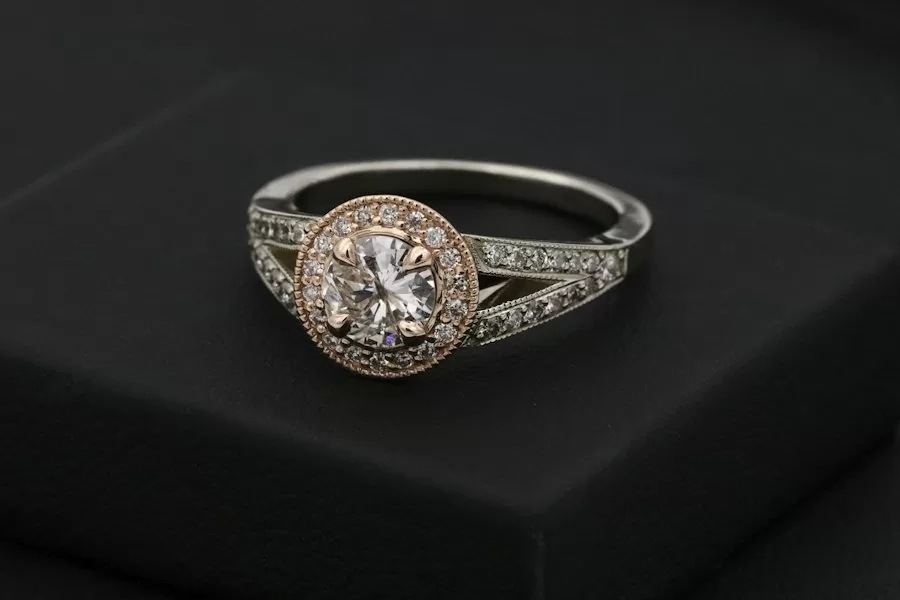
Most of the sparkle on a modern engagement ring does not come from the centre stone. It comes from the dozens of pinhead-sized diamonds marching around the band, lining a halo, or flanking the main stone in a three-stone setting. Those tiny stones are called melee, and they are the detail that separates a plain solitaire from a ring that catches light from every angle.
Melee is pronounced may-lay, and it is the trade word for small diamonds used as accents. The size range is broad, but in practice it covers stones from roughly 0.01 to 0.20 carats each, usually cut as tiny round brilliants. A pave setting might hold 30 to 60 of them; a full eternity band can carry well over a hundred.
How melee is sized and sold
Because individual melee are too small to sell one at a time, the trade sizes them by diameter and sells them by the cent or by the carat. Common sizes are 1.0 mm, 1.3 mm, 1.8 mm and 2.0 mm. A jeweller designing a ring will choose a size that matches the scale of the centre stone; a delicate 2 mm band uses 1.0 mm melee, while a wider band comfortably carries 1.8 mm stones. Larger melee, above about 0.15 carats each, start to cross into side-stone territory and may be sold individually.
The total carat weight of melee on a ring is usually a small fraction of the centre stone, often 0.10 to 0.50 carats in total. Yet because there are so many of them, they contribute a surprising amount to the price. A ring with a halo and a pave band can cost noticeably more than the same solitaire, even though the added weight is small. Understanding this helps when you compare quotes; a jump in price with no change in centre stone is almost always about the quality and quantity of the melee.
How the small stones are graded
Individual melee rarely receive their own grading reports. Instead, suppliers sort them into loose parcels by colour and clarity, and those parcels are inspected under magnification. A jeweller will typically specify the grade they expect: SI clarity melee, or H-I colour melee, for example. Higher-grade melee costs more, but because the stones are so small, a lower grade often looks identical to the eye.
This is a useful area to save money. A centre stone needs to be eye-clean and well cut because it is the focal point. The tiny melee around it, viewed at arm's length, will not show inclusions or a faint yellow tint the way a 1-carat stone would. Asking for SI to I1 clarity melee and G-I colour melee is standard practice and produces a ring that looks just as brilliant at a lower price. Reserve your budget for the clarity and colour of the centre stone instead.
Cut quality still matters
If there is one place you should not cut corners, it is the cut of the melee. A poorly cut tiny diamond looks dark and glassy, and a whole row of dark stones kills the sparkle of the ring. Wholesale parcels are graded for cut as well, and a reputable jeweller will pay a little extra for well-cut melee that flashes brightly. When you inspect a ring in the light, watch the band as you turn it: the small stones should shimmer in step with the centre stone, not sit there like dull beads of glass.
Cut quality is also why setting technique matters. Each melee needs to sit level in its seat, with the table facet facing straight up. A stone tilted at an angle loses most of its light return. The setting style you choose partly determines how carefully the small stones are placed, and a hand-finished pave will always outsparkle a mass-produced channel inlay.
Melee treatments and sourcing
Because melee is bought in bulk, treatment disclosure becomes more important than usual. Lower-grade melee is occasionally laser drilled, fracture filled, or even replaced by simulants in dishonest manufacturing. A reputable jeweller will tell you whether the accent stones are natural, mined, or lab grown, and whether any treatment has been applied. If the price of a heavily stoned ring seems unrealistically low, the small stones are the first place to question.
Sourcing is another conversation. Many buyers now choose lab grown melee for accent stones, which brings the cost of a fully stoned band down substantially without an obvious visual difference. This is one of the most practical places to consider a lab grown diamond, because the accent stones are small enough that the ethical and cost arguments outweigh the resale considerations that matter more for a centre stone.
Caring for tiny stones
Melee is held by tiny beads of metal, and those beads catch dirt, lotion and soap faster than a plain band does. A pave ring needs more frequent cleaning than a solitaire because oil builds up around each stone and dims its sparkle. A soft brush in warm soapy water is enough, and avoiding the household chemicals that can dull metal keeps the whole ring looking fresh. If a bead ever loosens and a stone drops out, a jeweller can usually replace a melee for a few pounds, but do not wear the ring until it is fixed because the gap catches more dirt and weakens the neighbouring beads.
The next time you try on a ring, pay attention to the small stones. Run your finger along the band, look for loose or tilted stones, and ask what grade the melee is. Those details tell you more about the quality of the craftsmanship than the certificate of the centre stone alone. Melee is where the craft lives, and a well-set row of tiny diamonds is the quiet luxury that makes a ring feel finished.
Gemstone grading terminology used here follows the Gemological Institute of America’s gem encyclopedia.
Related Reading
- I1, I2, I3 Clarity: What Included Diamonds Actually Mean
- Diamond Table and Depth Percentages: What the Numbers Actually Mean
- VS1 vs VS2 Diamond Clarity: Which Grade to Buy
Frequently Asked Questions
Is moissanite a good diamond alternative for retail buyers?
Yes for price-sensitive customers who want brilliance and hardness. Moissanite ranks 9.25 on the Mohs scale, holds up to daily wear and costs a fraction of a natural diamond of the same size, so it resells fast in bridal and fashion lines.
What is the minimum order for wholesale moissanite?
MOQ starts at 50 pieces per design for stock items. Custom cuts and private-label settings usually start at 100–300 pieces depending on the mold.
Do you provide certificates with moissanite stones?
Yes. Every parcel ships with GRA or IGI documentation listing carat weight, color grade and cut. We recommend passing the certificate to your end customer for trust.
How long does sample and bulk production take?
Samples ship in 3–5 days. Bulk runs take 15–20 days under 500 pieces, and 25–30 days for custom work.


