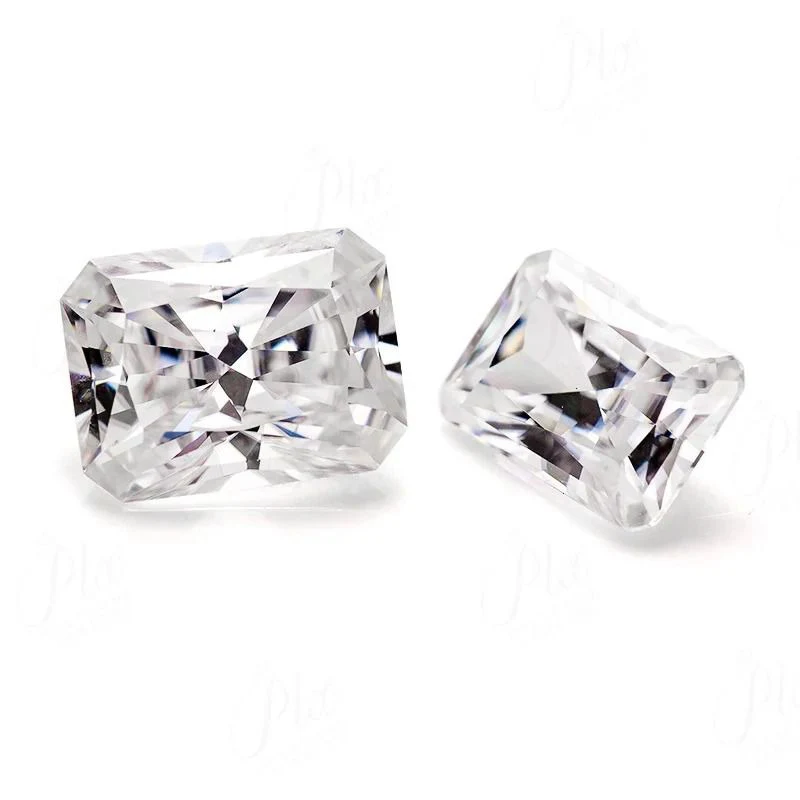
A 1.00ct round arrives graded VS1 and a near-identical one graded VS2, with a clear price gap between them. Ask a buyer which looks cleaner and most cannot tell, because both grades sit above the point where inclusions are visible to the unaided eye. The choice between VS1 and VS2 is really about where the inclusion sits, what it looks like, and how much the customer will ever look through a loupe. Here is how the two grades differ in practice.
What the VS grades mean
VS stands for Very Slightly Included. VS1 means inclusions are difficult to see under 10x magnification by a skilled grader; VS2 means they are easier to see under 10x, but still not visible to the naked eye face-up. Both grades sit above SI (Slightly Included) and well below I (Included) stones, where a flaw is visible without a loupe. The grading scale is documented on the GIA diamond clarity page. The key point: between VS1 and VS2, the naked-eye difference is essentially zero. The gap is about what a loupe reveals, not what a buyer sees on a hand.
Where the inclusion sits decides everything
Not all VS2 stones are equal. A VS2 with a tiny feather placed behind the pavilion, hidden by the setting or by the stone's depth, is effectively as clean face-up as a VS1. A VS2 with a black crystal dead-center on the table will show when the stone is tilted and magnified, even though it passes the naked-eye test. Conversely, a VS1 with a long white feather reaching toward the girdle is a weaker structural story than a clean VS2. This is why the grading report plot matters more than the two-letter grade: read the mapped inclusion. For the step below, see the SI1 versus SI2 eye-clean guide and the full clarity scale from IF to I1.
The price gap and when to take VS2
On a comparable 1ct round, VS1 typically commands about 8 to 15 percent over a VS2 of the same cut and color. That gap shrinks further in smaller stones (under 0.8ct) where the inclusions are simply too small to matter. VS2 is the smart buy when the inclusion is off-center or behind the pavilion, the setting will cover it, the stone is under 1ct, or the customer never plans to loupe it. VS1 earns its premium for stones over 1.5ct, where the larger surface area makes even small inclusions more likely to be spotted. Pair with how color and clarity trade off and where clarity fits a realistic budget.
What buyers get wrong about VS clarity
The trap is paying VS1 money for a VS2-equivalent stone whose inclusion is poorly placed, or skipping a genuinely clean VS2 because the grade sounds lower. Another trap is assuming a VS stone is eye-clean in every light; set stones under a magnifying jewelry light reveal more than daylight on a hand. The professional move is to request a side-by-side photo of two stones at the same price point and judge the face-up result, not the label.
How setting style changes the clarity math
The same VS2 stone reads differently depending on what holds it. A bezel or prong-heavy setting covers the outer edges, so an inclusion near the girdle disappears entirely, which makes a lower clarity grade a free win. A pavé or tension setting, by contrast, leaves more of the stone exposed, so a VS2 inclusion near the center has nowhere to hide. This is the reason a jeweler can sometimes step a customer from VS1 to VS2 and lose nothing: choose the stone after the setting, not before. If the planned mount covers the pavilion edges, lean on VS2; if the stone sits almost fully exposed in a solitaire, the VS1 premium buys peace of mind that no inclusion will ever be centered in view.
Can you see the difference between VS1 and VS2?
Not with the naked eye, which is the standard that matters on a hand. Under a 10x loupe a trained grader can separate them, but most buyers never look that close.
Is VS2 good enough for an engagement ring?
Yes. Most VS2 stones are eye-clean and represent the best clarity value in bridal, saving 8 to 15 percent over VS1 with no visible loss.
Which VS inclusion should I avoid?
Black crystals or long feathers placed near the center of the table or extending to the girdle. Feathers reaching the edge can risk chipping; clouds that cover the whole stone make it look hazy.
Should I step down from VS to save money?
Stepping to a well-chosen SI1 that is confirmed eye-clean saves more than stepping VS1 to VS2. The real saving is picking the lowest grade that still passes the naked-eye test.
If you are a jeweler building a clarity-tier bridal sheet, our wholesale team can send plotted-report photos and side-by-side loupe shots before stones ship. Request a VS1/VS2 comparison sheet.
Frequently Asked Questions
Is moissanite a good diamond alternative for retail buyers?
Yes for price-sensitive customers who want brilliance and hardness. Moissanite ranks 9.25 on the Mohs scale, holds up to daily wear and costs a fraction of a natural diamond of the same size, so it resells fast in bridal and fashion lines.
What is the minimum order for wholesale moissanite?
MOQ starts at 50 pieces per design for stock items. Custom cuts and private-label settings usually start at 100–300 pieces depending on the mold.
Do you provide certificates with moissanite stones?
Yes. Every parcel ships with GRA or IGI documentation listing carat weight, color grade and cut. We recommend passing the certificate to your end customer for trust.
How long does sample and bulk production take?
Samples ship in 3–5 days. Bulk runs take 15–20 days under 500 pieces, and 25–30 days for custom work.


