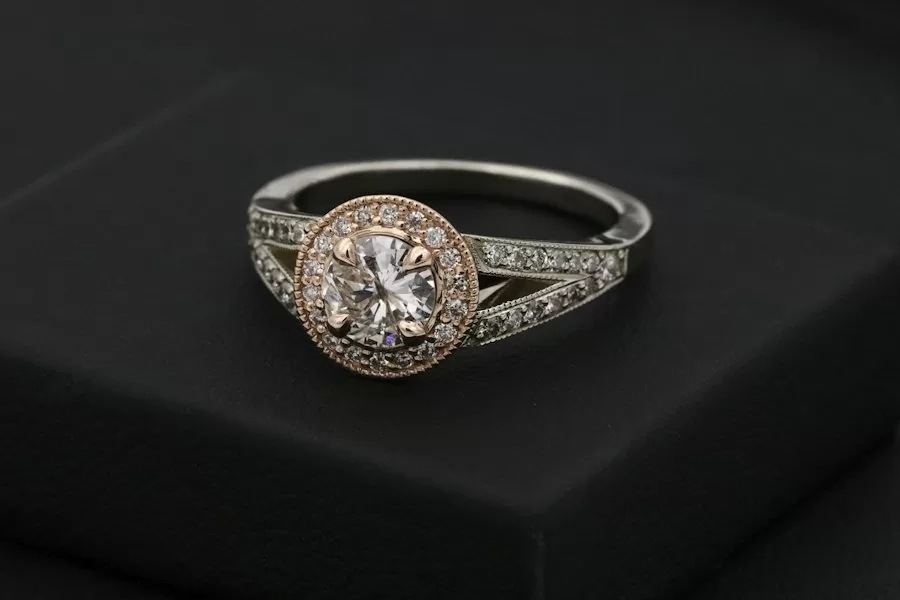
Few settings have reshaped the engagement ring market as fast as the halo. By circling a center stone with a border of tiny diamonds, a halo makes the center gem look bigger and floods the ring with extra sparkle. It is the reason a modest center stone can read as a much larger, much flashier ring. But the halo is not pure upside—the same design tricks that create the look also create practical trade-offs that buyers rarely hear about before they commit.
What a halo actually does
A halo setting places a paved or beaded border of small diamonds (called melee) around the center stone. The border catches light and reflects it back onto the center, which makes the center appear larger than its actual carat weight. It is a visual magnification trick: a one-carat center in a halo can read as a 1.5-carat stone face-up. The style comes in single halos, double halos, and split or offset halos, each adding more sparkle but also more metal and more tiny stones to maintain.
The pros
The biggest advantage is size perception for the budget. Instead of buying a larger, far more expensive center diamond, you spend a fraction of that money on accent stones and get a bolder face-up look. Halos also add a lot of sparkle per dollar, because the small stones catch light from every angle. Stylistically, they work well with virtually any center shape, and they tend to make the ring feel elaborate and premium even when the center stone is modest.
The cons
Here is the part sellers tend to gloss over. First, the added border raises the profile of the ring, so a halo catches on knits and hair more than a low solitaire. Second, all those tiny stones are held by tiny prongs, which means more places for stones to loosen over time—see checking prongs at home. Third, the extra crevices around the halo trap lotion, soap, and dust, so the ring needs more frequent cleaning to keep looking bright. Fourth, halos can be harder and more costly to resize because the jeweler has to work around the accent stones. Finally, because halos look larger than the center stone, upgrading the center later can mean redesigning the whole setting.
Who the halo suits best
A halo is a great fit if you want a wide, bright, eye-catching ring and you are willing to spend a little extra time on maintenance. It is especially popular with smaller center stones, colored centers, and people who love a glamorous, red-carpet look. If you prefer a low-profile, fuss-free band that slides easily under a glove or pairs flush with a wedding band, a solitaire or bezel setting may serve you better—see our guide to fitted wedding band height for how a tall halo complicates stacking.
Keeping it practical
Halo variations and their price
Not all halos cost the same. A single thin halo of small melee is the most affordable way to get the look, and it adds relatively little to the overall height. A double halo stacks two borders and reads more glamorous, but it doubles the number of accent stones and prongs, which pushes price and upkeep up with it. Split and offset halos break the border into sections for a modern, less symmetrical look. When budgeting, remember that the halo stones are charged as a group, so a ring with a modest center but an elaborate halo can cost nearly as much as a larger solitaire of the same total sparkle.
Photography also favors halos, which is one reason they dominate social feeds. The extra light makes the ring read beautifully on camera, but it is worth trying the ring on in natural daylight before deciding, because a halo that dazzles in a filtered photo can look heavier on a small hand than you expect. Balance the width of the halo against the width of your finger, and try stacking it with your planned wedding band at the same appointment so the fit is proven rather than hoped for.
If you go halo, choose a reputable maker and ask how the accent stones are secured. Bead-set and pavé halos with evenly sized melee tend to wear better than uneven, loosely set borders. Budget for an annual prong check, and plan to clean the ring at home every couple of weeks. Done right, a halo is one of the most satisfying ways to get a big look without a big center-stone bill—as long as you go in knowing the upkeep. When the maintenance fits your lifestyle, that extra sparkle pays for itself every time the ring catches the light.
The Wikipedia entry on engagement rings gives an independent overview of engagement ring traditions and settings.
Related Reading
- HPHT vs CVD Lab-Grown Diamonds: The Basics Buyers Ask
- When Your Ring Size Changes: Day to Day, Season to Season
- How Lab-Grown Diamonds Are Priced
Frequently Asked Questions
What ring sizes can you supply in bulk?
US sizes 5–12 including half sizes. Send a size breakdown with your order and we cast to that curve; comfort-fit inner bands reduce resize requests.
Can I order a mixed size run instead of one size?
Yes. Mixed runs are standard for wholesale: specify quantity per size and we pack and label by size at no extra labor cost.
What is the MOQ for custom ring designs?
50 pieces per design for existing molds; 100–300 pieces when a new mold or CAD model is required.
How should I price rings for retail margin?
Most partners use a 3–4x markup on FOB cost for sterling and 2.5–3x for moissanite solos, which keeps landed cost under 30% of retail.


