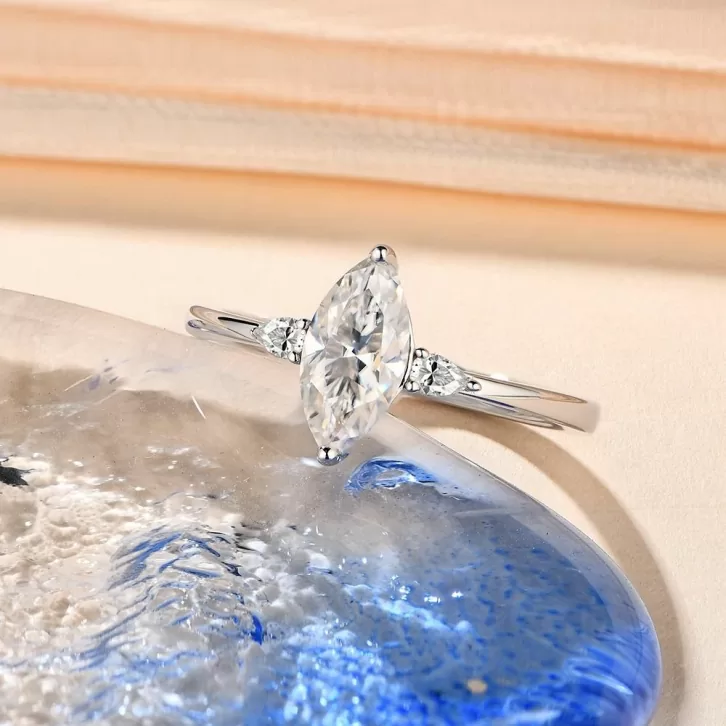
If you have never worn a fine ring before, the question of which finger an engagement ring sits on sounds simpler than it is. In the UK, Ireland and most of Western Europe the answer is the third finger of the left hand — but that is only the modern, local convention, and the reasons behind it are more folklore than anatomy. This is the plain version, including the countries that do the opposite.
The left-hand third finger, explained
Across the UK, Ireland, France, Spain, the Netherlands and most of the US, engagement and wedding rings are worn on the left hand's third finger, between the index and the little finger. The Romans believed a vein ran directly from that finger to the heart — the vena amoris, or vein of love. Modern anatomy does not bear that out; every finger has a similar venous network. But the tradition stuck, and the romance of it is why the convention survived.
The countries that wear it on the right
A surprising number of European nations place the wedding ring on the right hand instead. Germany, Austria, Norway, Denmark, Greece, Russia, Poland and Bulgaria all use the right hand for the wedding band. In some countries the engagement ring starts on the right and the wedding band replaces it there; in others the switch happens at the ceremony. If you are buying a ring for a partner raised in one of these traditions, ask — it changes which finger you size for, and resizing a surprise ring is easier than resizing the wrong finger.
| Country / region | Engagement ring | Wedding band |
|---|---|---|
| UK, Ireland, US | Left, third finger | Left, third finger |
| France, Spain, Netherlands | Left, third finger | Left, third finger |
| Germany, Austria, Scandinavia | Often left, then switched | Right, third finger |
| Russia, Greece, Poland | Right hand | Right hand |
What the other fingers say
Wearing a ring on another finger is not loaded the way it used to be, but the old associations still shape how people read them:
- Index finger: authority, family crests; reads as a statement piece.
- Middle finger: no fixed meaning; a common choice for a right-hand ring.
- Little finger (pinky): signet rings, often heirloom, no marital meaning.
- Thumb: independent, modern; wide rings work well here.
Practical notes for the buyer
The order of the rings on the finger
In UK tradition, the engagement ring sits on the third finger of the left hand during the engagement. At the wedding, the band is usually slipped on first, closest to the heart, and the engagement ring is then moved back on top of it. Some people swap the order afterwards; it is a personal choice. What matters is that the two rings are compatible in height — a thick engagement basket and a thin flat band will not sit flush, which is why couples increasingly order them together. If you have ever wondered why your grandmother's engagement ring sat oddly against her wedding band, that mismatch is usually the reason.
Right-hand rings: the modern choice
An increasing number of women choose a 'right-hand ring' — a dress ring or a stack worn on the right hand's ring finger, with no marital meaning attached. It is a fashion statement rather than a signal. If you are buying a ring to surprise someone and you are unsure whether their existing right-hand ring is meaningful, ask a friend; the last thing you want is to give an engagement ring on a finger that already carries a style ring she wears daily.
If you are buying a ring from a jeweller in the UK, they will assume the left ring finger unless you say otherwise, and that is fine for most British couples. If your partner's family comes from a right-hand tradition, it is a two-minute conversation worth having before the ring is sized, because resizing a surprise ring is easier than resizing the wrong finger. There is no penalty for asking; there is only a small penalty for guessing wrong. And if the two of you later prefer to wear the rings on the other hand for comfort, that is entirely your choice — the convention is a starting point, not a rule you have to keep. Most couples land on the left ring finger simply because that is what everyone around them does, and that works perfectly well.
The hand you choose is, in the end, a matter of family habit and personal preference more than rule. What matters practically is that the ring is sized for the finger it will live on, and that you have thought about whether a future wedding band will sit beside it in comfort. None of these customs (FTC jewelry industry guides) carries a penalty if you break it; they are just conventions that help you decide. Which is why we cover the mechanics in our ring resizing guide.
The history and conventions of engagement rings are outlined in the Wikipedia entry on engagement rings.
Related Reading
- HPHT vs CVD Lab-Grown Diamonds: The Basics Buyers Ask
- When Your Ring Size Changes: Day to Day, Season to Season
- How Lab-Grown Diamonds Are Priced
Frequently Asked Questions
What ring sizes can you supply in bulk?
US sizes 5–12 including half sizes. Send a size breakdown with your order and we cast to that curve; comfort-fit inner bands reduce resize requests.
Can I order a mixed size run instead of one size?
Yes. Mixed runs are standard for wholesale: specify quantity per size and we pack and label by size at no extra labor cost.
What is the MOQ for custom ring designs?
50 pieces per design for existing molds; 100–300 pieces when a new mold or CAD model is required.
How should I price rings for retail margin?
Most partners use a 3–4x markup on FOB cost for sterling and 2.5–3x for moissanite solos, which keeps landed cost under 30% of retail.


