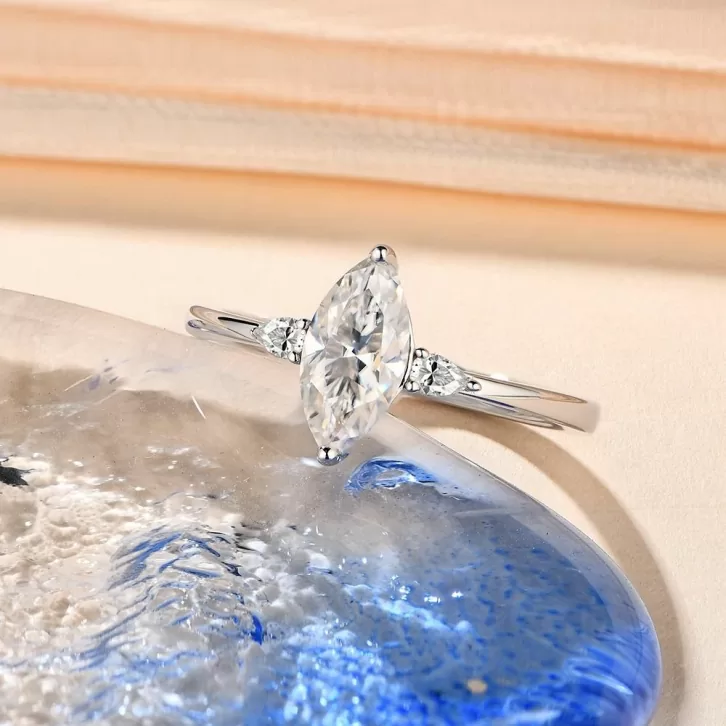
A ring is small enough to forget on a hotel bedside, and expensive enough that losing it ruins a holiday. Most jewellery is lost not on the beach but in transit — through security trays, hotel rooms, and the pocket of a jacket left on a plane. This is the practical version of how to travel with a ring or wedding set without that worry hanging over the trip.
Pack it in your hand luggage, never the hold
Hold luggage gets misrouted, opened and rifled through. Put the ring in your carry-on, ideally in a small hard pouch inside your hand-luggage bag, not loose in a side pocket. If you are travelling to propose on holiday, carry the ring on your person — in a zipped jacket pocket or a neck pouch — rather than in a checked case. The ring box is bulky; for a flight, a slim jewellery roll or a small cloth pouch is easier to conceal through security.
Airport security: what actually happens
- A wedding or engagement ring can usually stay on through the metal detector unless it triggers the alarm. If it does, you may be asked to remove it — keep it on your hand, not in a tray, where it can be overlooked.
- Do not put jewellery in the grey security tray if you can avoid it. Trays move fast and things get left behind.
- Duty-free jewellery bought airside goes into a sealed bag — keep that bag sealed until you reach your final destination.
- If you are travelling through more than one airport, keep the ring on after the first scan; removing and replacing it is where mistakes happen.
| Situation | What to do | Common mistake |
|---|---|---|
| Airport security | Keep ring on your hand | Leaving it in a tray |
| Hotel room | Use the room safe | Leaving it by the sink |
| Beach / pool | Leave it in the safe | Taking it off on the sand |
| Going through customs | Carry proof of ownership | No receipt on a £5k ring |
Insurance while you are abroad
Check your policy covers you outside the UK before you fly. Many specialist jewellery policies include worldwide cover as standard, but home policies often quietly restrict away-from-home cover to the UK or to a low single-item limit. If the ring is worth more than your away-from-home limit, you are under-insured for the trip. Take a photograph of the ring, a note of the insurance policy number, and a copy of the valuation, stored on your phone and with a partner back home. If the ring is stolen abroad, you will need a police report for the claim — ask for a written report at the local station and keep it.
The proposal-abroad extra
The hotel room is where rings go missing
Airports are where people worry, but hotels are where rings are actually lost. The pattern is always the same: take the ring off to shower, leave it on the sink, pack up in a hurry, and it goes in the bin bag or behind a washbasin. The habit that prevents this is to have one fixed place for the ring whenever it comes off — the hotel room safe, every time. Do not balance it on a towel, do not leave it by the sink, do not put it in a jacket pocket you then send to the laundry. One place, every time.
A ten-second packing checklist
- Ring in a soft pouch inside your hand luggage, not the hold.
- Photograph the ring and note your policy number, saved on your phone.
- Carry the valuation or a receipt photocopy if the ring is high value.
- Use the room safe whenever the ring comes off.
- Wear the ring home through customs rather than packing it boxed.
Rings on the plane: wear or pack?
The simplest rule is to wear the ring through the flight rather than pack it. A ring on your finger cannot be lost by the airline, forgotten in a hotel safe, or stolen from a checked bag. The exception is if you are proposing mid-flight — then the ring stays in a zipped pouch in your hand luggage until the moment you need it. On the return flight home, after the trip, wearing the ring through customs is also the smoothest way to bring it back without questions.
If you are proposing on holiday, the ring is out of its box, handled, hidden and then photographed. That is the window in which it gets left in a restaurant or a taxi. Choose the hiding place before you leave home, and tell one trusted person back home where the ring will be. For the insurance side of owning the ring in the first place, our ring insurance cost guide sets out what to look for in the policy. Done right, the ring travels with you and comes home with you, and the holiday is remembered for the proposal, not the panic.
For HS classification of jewellery in customs and export documentation, the WCO Harmonized System nomenclature is the authoritative nomenclature.
Authoritative References
For buyers who need to verify the technical and regulatory basis of this guide, the following independent institutions publish authoritative reference data:
- ISO 9001 Quality Management - the international standard for consistent production quality.
- Wikipedia: Jewellery - manufacturing processes, materials and global trade background.
Related Reading
- HPHT vs CVD Lab-Grown Diamonds: The Basics Buyers Ask
- When Your Ring Size Changes: Day to Day, Season to Season
- How Lab-Grown Diamonds Are Priced
Frequently Asked Questions
What ring sizes can you supply in bulk?
US sizes 5–12 including half sizes. Send a size breakdown with your order and we cast to that curve; comfort-fit inner bands reduce resize requests.
Can I order a mixed size run instead of one size?
Yes. Mixed runs are standard for wholesale: specify quantity per size and we pack and label by size at no extra labor cost.
What is the MOQ for custom ring designs?
50 pieces per design for existing molds; 100–300 pieces when a new mold or CAD model is required.
How should I price rings for retail margin?
Most partners use a 3–4x markup on FOB cost for sterling and 2.5–3x for moissanite solos, which keeps landed cost under 30% of retail.


