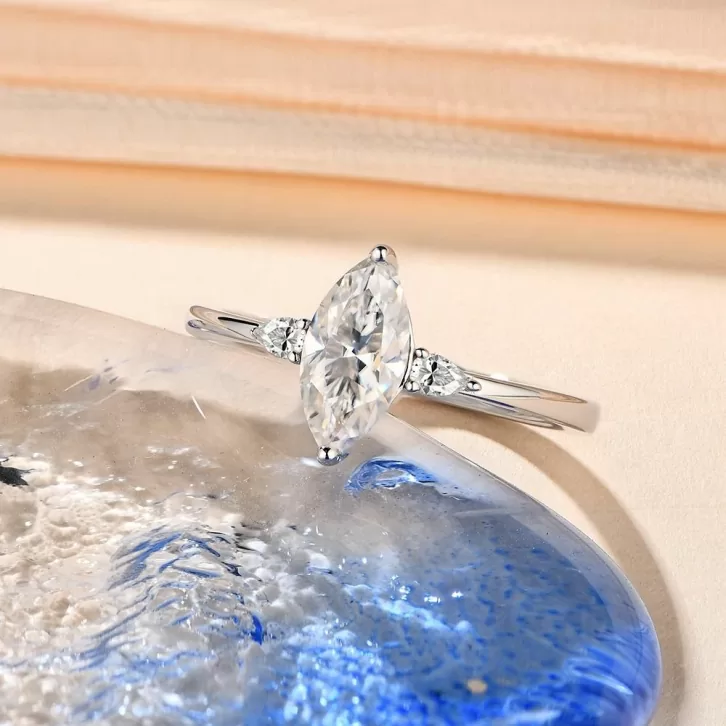
The two most popular engagement ring settings in the English-speaking world are the solitaire and the halo. One puts a single centre stone on a pedestal. The other surrounds that centre stone with a circle of smaller stones. They both look beautiful, but they solve different problems and suit different people. Before you compare prices or browse where to buy, it helps to understand what you are actually choosing between.
What a solitaire does
A solitaire ring has one centre stone held by prongs, a bezel or a tension setting, with little or nothing else on the band. All the visual attention lands on that stone. If you have picked out a particularly well-cut diamond or moissanite and you want its fire and brilliance to be the star, a solitaire is the cleanest way to show it. The setting is also easier to clean because there are fewer gaps for soap and lotion to hide in.
Solitaires tend to read classic, elegant and timeless. They photograph well because the eye goes straight to the stone. They also stack neatly with a wedding band, since there are no surrounding stones to fight the band's height.
What a halo does
A halo setting wraps the centre stone in a ring (or two rings) of smaller accent stones. The effect is twofold. First, the centre stone looks larger than its actual carat weight because the surrounding stones extend its outline. Second, the extra facets add a burst of sparkle that makes the whole ring look brighter from across a room.
Halos are popular with buyers who want the look of a bigger stone without paying for a bigger centre carat. They also suit people who love a glamorous, high-drama look. Vintage-style rings, art deco designs and many moissanite engagement rings use halos to maximise the already strong fire of the stone.
Size perception: the honest trade-off
A halo makes a 1-carat centre stone look closer to 1.5 carats in overall footprint. That is real value if a larger mined diamond is out of budget. But the centre stone itself is still 1 carat. If you ever have the ring valued or resold, the centre stone is what carries most of the value; the small accent stones contribute very little. So a halo is a style and optics choice, not a secret way to buy a bigger diamond.
Cost comparison
For a given centre stone, a halo usually costs a bit more than a plain solitaire because of the extra small stones and the extra labour to set them. On the other hand, you can choose a smaller, cheaper centre stone and still get a big-looking ring. Solitaires often work out cheaper for the same total visual size. The right answer depends on whether you would rather spend on centre-stone quality or on surrounding sparkle.
Durability and upkeep
Here is where the two settings diverge in everyday life. Solitaries have fewer moving parts and fewer small stones to come loose. A halo has a whole ring of tiny stones, each held by its own minuscule prongs. Those tiny prongs can catch on hair, clothing and bedding, and over time one of the small stones can work loose. Halo rings benefit from an annual check-up to make sure the accent stones are tight. See our guide on checking prongs at home for what to look for between jeweller visits.
Halo bands also tend to sit a little taller and wider, which can make them less comfortable to stack with a wedding band unless you order a fitted or contoured band.
Style and lifestyle fit
Choose a solitaire if you want a clean, minimal look; if you work with your hands and prefer a setting that does not catch; or if the centre stone's cut and clarity are the whole point. Choose a halo if you love maximum sparkle, want visual size, or are drawn to vintage and ornate designs. People with active jobs often lean solitaire, while people who wear their ring as a statement piece often lean halo.
Can you have both?
Yes. A three-stone ring, a thin hidden halo, or a solitaire with pavé shoulders gives you a middle ground. A hidden halo sits just under the centre stone, adding sparkle from the side without widening the front outline. These hybrids are worth trying on if you keep changing your mind. They also tend to age well, because a hidden halo adds drama without the full ring of tiny prongs that a traditional halo needs to maintain.
Trying them on
Pictures online can be misleading. A halo that looks huge on a model with thin fingers can look busy on a wider hand. Try both styles on your own hand, in natural light, and notice which one you keep glancing at. The ring you think about while it is on your finger is the one that will feel right for the next few decades.
For third-party reference, the Wikipedia article on moissanite details moissanite’s discovery, optical properties and use in jewellery.
Related Reading
- HPHT vs CVD Lab-Grown Diamonds: The Basics Buyers Ask
- When Your Ring Size Changes: Day to Day, Season to Season
- How Lab-Grown Diamonds Are Priced
Frequently Asked Questions
What ring sizes can you supply in bulk?
US sizes 5–12 including half sizes. Send a size breakdown with your order and we cast to that curve; comfort-fit inner bands reduce resize requests.
Can I order a mixed size run instead of one size?
Yes. Mixed runs are standard for wholesale: specify quantity per size and we pack and label by size at no extra labor cost.
What is the MOQ for custom ring designs?
50 pieces per design for existing molds; 100–300 pieces when a new mold or CAD model is required.
How should I price rings for retail margin?
Most partners use a 3–4x markup on FOB cost for sterling and 2.5–3x for moissanite solos, which keeps landed cost under 30% of retail.


