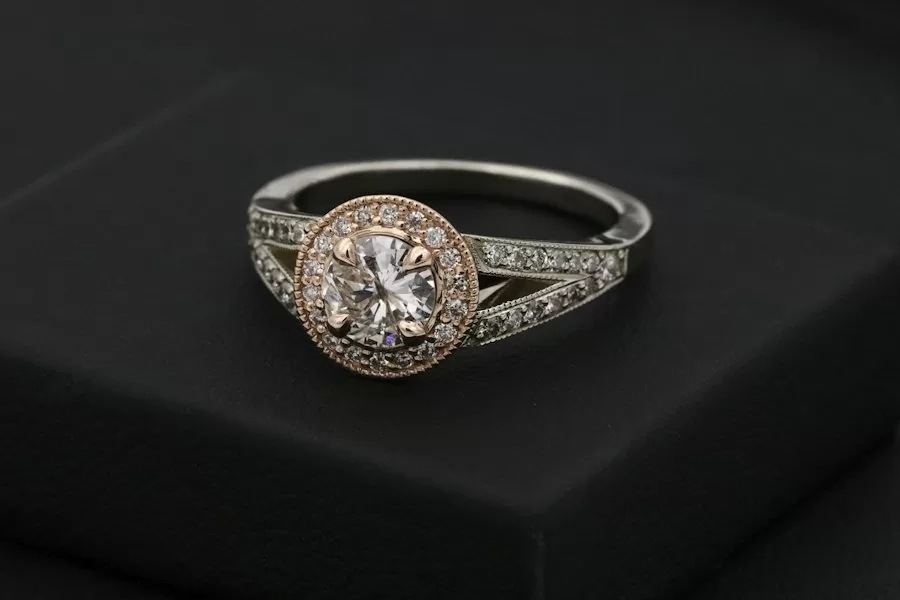
Walk into any modern jewellery store and roughly half the engagement rings in the case will be a halo. The style has been dominant for well over a decade, and it is easy to see why: a halo makes a modest centre stone look dramatically larger and more sparkly than it actually is. That does not mean it is the right choice for everyone. The halo is a design with real benefits and real costs, and most buyers only hear about the first half.
What a halo actually does
A halo is a circle of small diamonds (or moissanite) set around the centre stone, usually held in place by tiny prongs or pavé beads. The visual effect is twofold. First, the ring of side stones extends the overall face-up size, so a one-carat centre can read like a two-carat ring from across a room. Second, the extra facets reflect light back into the centre stone, which makes the centre look brighter than it would on its own. This is the halo's whole marketing pitch, and it works.
The visual-size benefit is real
If your budget buys a 0.7-carat centre stone but you want a ring that reads as 1.2 carats on the hand, a halo is the cheapest way to get there. The outer ring of small diamonds costs far less per carat than upgrading the centre, because melee stones are priced in bulk. For buyers who care about finger presence rather than raw carat weight under a loupe, the halo is honest value. Face-up size is measured in millimetres, not carats.
Brilliance trade-offs
The same ring of small stones that adds sparkle also adds visual noise. On a very clean, well-cut centre stone, the halo can distract from the stone's own fire. On a slightly dull or included centre, the halo actually masks the problem by drawing the eye outward. People who love a minimalist solitaire tend to find halos busy; people who love maximum sparkle tend to find solitaires dull. There is no objective winner.
Maintenance and snagging
This is where the halo's costs start. Every small diamond in the halo is held by tiny prongs or beads, and those tiny prongs catch on knitwear, hair, and bed linen. Over years, they bend. A bent prong in a solitaire means one problem to fix; a bent prong in a halo means one of dozens. Most halo owners find themselves at the jeweller for prong checks every six months rather than every year. Our guide on checking prongs at home covers the simple tap-and-feel test you can run on your own ring.
Resizing a halo
A plain band resizes cleanly. A halo resizes less cleanly, because the pavé stones along the shank can shift when the metal is stretched or squeezed. Many jewellers will not resize a fully set halo more than half a size without re-tipping stones. If you are between sizes, get the fit right before you order rather than assuming you can adjust later.
Halo and resale
On the secondary market, a halo is harder to resell than a solitaire. Buyers of pre-owned rings usually want the centre stone and a clean setting they can redesign around. The small side stones add cost to the new buyer (re-tipping, cleaning, possibly replacing missing melee) without adding much value. If resale matters to you, a solitaire in a plain setting is more liquid. The secondary market for elaborate settings is thinner than for plain solitaires.
Halo vs solitaire cost
A halo ring with a 0.9-carat centre often costs the same as a solitaire with a 1.2-carat centre, because the halo melee and the extra setting work add up. If you compare like for like on price, the solitaire usually wins on raw stone quality. If you compare like for like on visual size, the halo usually wins. Decide which comparison matters to you before you walk into the store.
Pairing with a wedding band
A halo sits higher on the finger than a solitaire, and the outer ring of stones often leaves no room for a straight wedding band to sit flush. Most halo owners end up with a contoured, notched, or curved band, or they wear the two rings on different occasions. If you plan to stack daily, plan the wedding band at the same time as the engagement ring. Our guide to stack height and fitted bands covers the geometry.
Double halos and hidden halos
The halo category has split. A double halo stacks two rings of side stones for even more presence, at the cost of even more prongs and an even higher profile. A hidden halo puts the side stones underneath the centre, where they glow from below but do not extend the outline. Hidden halos are a good compromise: they add sparkle without the snagging and the stacking problems. If you like the halo idea but not the upkeep, ask to see a hidden halo on a similar centre stone.
Who should (and should not) choose a halo
Choose a halo if you want maximum visual size on a modest budget, you love a high-sparkle look, and you are comfortable with bi-annual prong checks. Skip the halo if you want a low-profile ring for active hands, if you plan to resize later, if resale value matters, or if you prefer a minimalist aesthetic. The halo is a wonderful design, but it is not the default it is often presented as. Setting styles compared side by side, in our setting styles guide, helps you weigh halo, prong, and bezel on equal terms.
For third-party reference, the Wikipedia article on moissanite details moissanite’s discovery, optical properties and use in jewellery.
Related Reading
- HPHT vs CVD Lab-Grown Diamonds: The Basics Buyers Ask
- When Your Ring Size Changes: Day to Day, Season to Season
- How Lab-Grown Diamonds Are Priced
Frequently Asked Questions
What ring sizes can you supply in bulk?
US sizes 5–12 including half sizes. Send a size breakdown with your order and we cast to that curve; comfort-fit inner bands reduce resize requests.
Can I order a mixed size run instead of one size?
Yes. Mixed runs are standard for wholesale: specify quantity per size and we pack and label by size at no extra labor cost.
What is the MOQ for custom ring designs?
50 pieces per design for existing molds; 100–300 pieces when a new mold or CAD model is required.
How should I price rings for retail margin?
Most partners use a 3–4x markup on FOB cost for sterling and 2.5–3x for moissanite solos, which keeps landed cost under 30% of retail.


