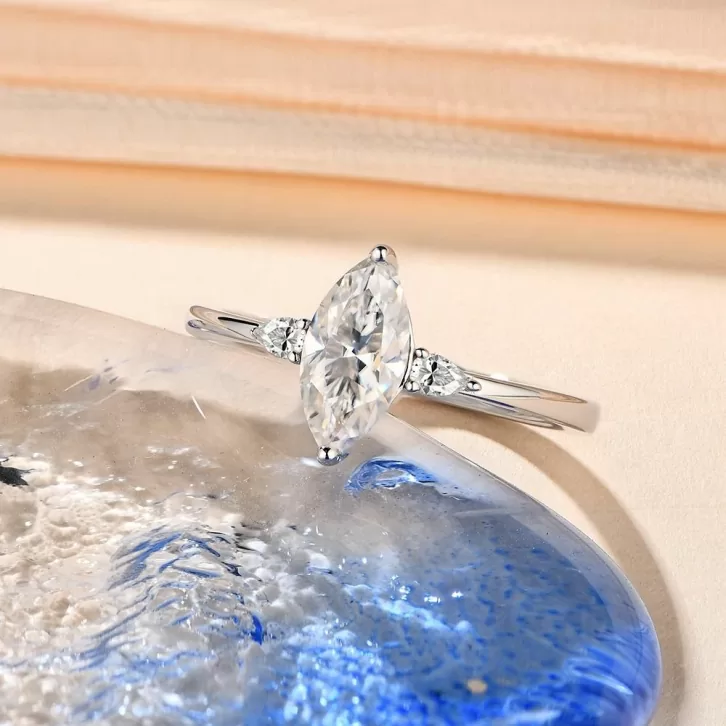
A 1-carat diamond looks very different on a size 4 finger than on a size 8. The carat weight tells you the mass of the stone; it tells you almost nothing about how big the ring will look on the customer's hand. That gap is where buyers either overspend or end up disappointed, and it is a detail worth explaining clearly before the order is placed.
Carat weight is not the same as face-up size
Carat is a unit of mass (200 mg per carat). Two stones of the same weight can have very different visible diameters depending on cut. A deep-cut 1-carat round may measure 6.2mm across the face, while a well-proportioned one measures about 6.5mm. The relationship is formalized on the GIA carat weight guide. The point for buyers is that you can sometimes buy a 0.9 carat that looks nearly as large as a 1.0 carat and save meaningfully. Our side-by-side in 1ct vs 2ct on the hand gives the visual reference most customers want.
Finger width changes everything
A narrow finger makes a given stone look larger; a wide finger makes it look smaller. A 1-carat solitaire on a slender size 4 finger reads substantial. The same stone on a wider size 8 finger looks modest. General rule of thumb: on a smaller finger, 1 carat is a classic, balanced look; on a larger finger, 1.5 to 2 carats reads proportionate. The ring's width matters too: a slim band (1.5-2mm) makes the stone look bigger, while a wide band crowds the finger visually. That proportion logic also ties into the sizing notes in choosing a ring size at home.
Shape and setting create optical size
Elongated shapes (oval, pear, marquise) have a larger face-up length than a round of equal carat, so they look bigger for the money. A halo setting multiplies the perceived size by surrounding the center stone with smaller diamonds. These are the legitimate ways to get visual impact without buying more carat weight. The 4Cs tradeoff context is in the 4Cs for first-time buyers, and budget planning is in a realistic engagement ring budget.
Managing expectations before purchase
Ask for the customer's ring size, preferred band width, and a photo of the hand if possible. Match the stone diameter to the finger rather than shopping by carat alone. A 0.90 carat on a slender finger with a halo and slim band often outperforms a 1.2 carat on a wide finger with a thick band.
A rough millimeter guide by finger size
Instead of shopping by carat, shop by face-up millimeter. A well-cut round 0.5 carat is about 5.1mm, 1 carat is about 6.5mm, 1.5 carats is about 7.4mm, and 2 carats is about 8.1mm. On a slender size 4 to 5 finger, 6.5mm reads as a classic, balanced solitaire. On a size 7 to 8 finger, that same 6.5mm starts to look modest, and 7.4 to 8mm reads as the fuller, more deliberate choice. Those few millimeters are the whole difference between "nice ring" and "statement ring," and they are worth discussing before the budget is set.
Elongated shapes stretch those numbers visually. A 1-carat oval is about 8 by 6mm, so its length reads larger than a round of the same weight even though the mass is identical. This is why oval and pear engagement rings consistently feel bigger on the finger than rounds at the same carat price. If the goal is maximum presence per dollar, an elongated shape plus a slim band is the most direct route. Show the customer a millimeter chart alongside their finger size and the decision becomes visual rather than arithmetic, which removes most of the back-and-forth.
Do not forget that the ring itself also changes proportion. A high six-prong solitaire lifts the stone off the finger and makes it read larger, while a low bezel sits close and reads smaller. These setting choices are free ways to tune the apparent size once the customer has chosen their target millimeter range.
FAQ
Does a 1 carat diamond look small?
It depends on the finger. On a narrow size 4-5 it looks classic and balanced; on a wider size 7-8 it can look modest. Finger size, not just carat, sets the expectation.
Which carat looks biggest for the money?
Elongated shapes such as oval and pear give more face-up length per carat, and a halo setting adds perceived size. Deep-cut rounds waste mass in depth.
Should I size up in carat for a wider finger?
Often yes. Moving from 1.0 to 1.5 carats, or adding a halo, restores visual proportion on a wider finger.
Does ring band width affect how big the diamond looks?
Yes. A thinner band makes the center stone look larger; a wider band fills the finger and makes the stone appear smaller by comparison.
We supply stones with measured millimeter diameters in every listing, so you can match face-up size to the customer's finger before ordering. Request size-comparison photos.


