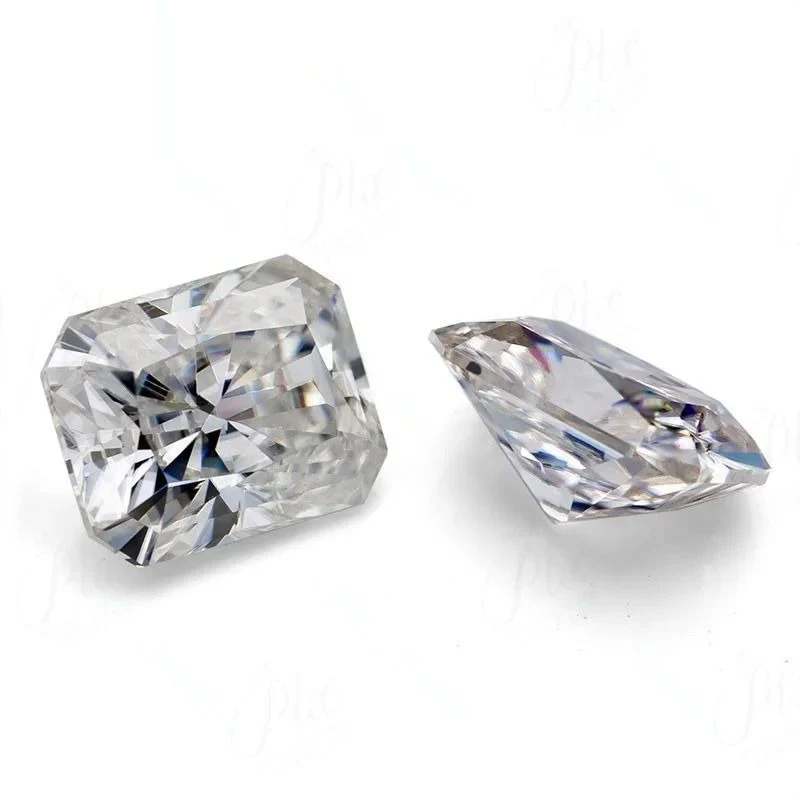
A budget client wants a white center stone that is not a diamond and lands well below a traditional ring price. Two candidates come up: moissanite and white sapphire. Both are white, both rank near the top of the Mohs scale, but they look and behave differently. Here is the side-by-side trade-off.
Hardness and everyday durability
White sapphire is a corundum at 9 on the Mohs scale, second only to diamond (10). Moissanite registers about 9.25, which is marginally harder and very close in practice. Both resist scratching far better than quartz or topaz, and both are realistic for daily wear on an engagement ring. The difference is not scratch resistance but how each stone handles chips at the edges. Sapphire has a slightly tougher brittleness; moissanite is stable but can show wear on small stone settings. Context on moissanite on Wikipedia.
Refractive index, fire and sparkle
This is where the two diverge. Moissanite has a refractive index of about 2.65 to 2.69 and double refraction, meaning light bends twice as it passes through. It returns strong brilliance and noticeably more fire (rainbow flashes) than diamond. White sapphire has a refractive index around 1.76 to 1.77, so it looks quieter, grayer and less brilliant in comparison. Clients who want a diamond-like sparkle usually lean moissanite; clients who want a matte, subtle white stone often choose sapphire.
Color and clarity from the start
White sapphire, even when sold as "white," often carries a faint gray or milkiness that keeps it from looking like a colorless diamond. Moissanite is cut to be near-colorless (graded D to F equivalent) and can carry a slight warm or greenish tint in larger sizes, which newer high-grade moissanite minimizes. Neither is a diamond, but moissanite imitates diamond appearance more closely.
Price, origin and setting
White sapphire is the cheaper stone per carat and is available natural or lab-grown. Moissanite is more expensive than sapphire but still a fraction of a diamond. Both work in the solitaire and three-stone mounts covered in three-stone vs solitaire. For how moissanite holds up over years, read moissanite hardness for daily wear, and for a common lookalike comparison see moissanite vs cubic zirconia.
FAQs
Is moissanite better than white sapphire for an engagement ring?
For diamond-like sparkle, moissanite wins. For a quieter, subtler white look and a lower price, white sapphire is reasonable. Both are durable enough for daily wear.
Which is harder, moissanite or white sapphire?
Moissanite is about 9.25 on the Mohs scale, slightly above white sapphire at 9. In real wear the difference is negligible; both resist scratches well.
Does white sapphire look like a diamond?
Not closely. Its lower refractive index makes it look quieter and often slightly gray or milky, whereas moissanite returns more brilliance and fire.
Can moissanite be used in an everyday ring?
Yes. At 9.25 Mohs it is durable enough for daily wear, though small stone settings should be checked for loose stones periodically.
Cost per carat and long-term value
Price separates the two most clearly. White sapphire is the budget option, often priced well under moissanite per carat, and a 1-carat white sapphire center ring can land at a fraction of a diamond. Moissanite costs more per carat but still lands at a fraction of a comparable diamond, and a 1-carat equivalent moissanite usually runs in the low hundreds to a few hundred dollars depending on grade and cut. For a client who wants a white stone that looks like a diamond, the extra cost over sapphire buys the brilliance and fire that sapphire cannot match.
Resale expectations should be set honestly. Neither stone holds diamond-level resale value, and both are sold primarily for their look rather than their investment worth. Moissanite is lab-created and consistent in supply, so replacement is easy if a stone is lost or chipped. White sapphire, whether natural or lab-grown, is also replaceable, but the natural supply carries a small premium. The right choice comes down to look: clients who want quiet and matte choose sapphire; clients who want sparkle choose moissanite.
On care, both stones clean easily. Moissanite does not absorb oils and can be wiped with a soft cloth and mild soap, though its double refraction means it shows facet doubling when viewed closely, which is a recognized trait rather than a flaw. White sapphire is equally low-maintenance and scratches less visibly because its quieter surface hides fine marks. For an everyday ring, both stones can be worn without the daily care a higher-value diamond demands, which is part of their appeal for active clients on a budget. A yearly prong check is still wise for either stone set in a delicate mount.
HOLYCOME supplies calibrated moissanite and lab-grown white sapphire in matched rounds and cushions. Trade partners can request a sample parcel to compare sparkle in person.
Frequently Asked Questions
Is moissanite a good diamond alternative for retail buyers?
Yes for price-sensitive customers who want brilliance and hardness. Moissanite ranks 9.25 on the Mohs scale, holds up to daily wear and costs a fraction of a natural diamond of the same size, so it resells fast in bridal and fashion lines.
What is the minimum order for wholesale moissanite?
MOQ starts at 50 pieces per design for stock items. Custom cuts and private-label settings usually start at 100–300 pieces depending on the mold.
Do you provide certificates with moissanite stones?
Yes. Every parcel ships with GRA or IGI documentation listing carat weight, color grade and cut. We recommend passing the certificate to your end customer for trust.
How long does sample and bulk production take?
Samples ship in 3–5 days. Bulk runs take 15–20 days under 500 pieces, and 25–30 days for custom work.


