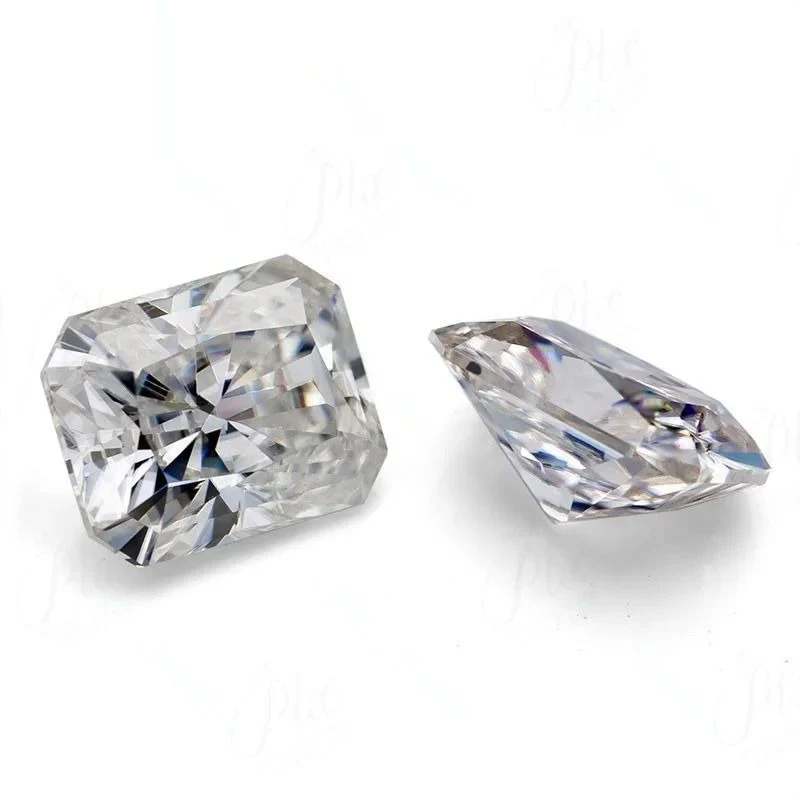
At first glance, moissanite and cubic zirconia (CZ) look like the same product: a bright white, affordable diamond lookalike sold at a fraction of diamond prices. The numbers tell a different story. Moissanite has a refractive index of roughly 2.65 to 2.69, while cubic zirconia sits around 2.15 to 2.18. Diamond itself is 2.42. Those numbers, plus hardness and dispersion, are why one gemstone is sold as a lifetime engagement ring and the other as a fashion piece. See IGI gemstone reference material for the grading context behind these figures.
What refractive index does
Refractive index (RI) measures how much light bends as it enters a material. A higher RI bends light more sharply, which means more light reflects back out of the top of the stone instead of leaking through the sides. That return of light to your eye is what people call "brilliance." Moissanite's RI of 2.65 is higher than diamond's 2.42, so a well-cut moissanite can actually look livelier and more reflective than a diamond of the same size. CZ at 2.15 returns less light, which is why cheap CZ rings look flat and glassy next to either.
Dispersion: the rainbow flashes
Dispersion (sometimes called "fire") measures how much white light splits into color as it passes through the stone. Moissanite has dispersion around 0.104, nearly double diamond's 0.044. CZ sits around 0.058, between the two. In practice, moissanite throws more rainbow flashes, especially under bright overhead light; some buyers love it, others find it less subtle than diamond. CZ is closer to diamond in fire but weaker in overall brilliance. Neither flaw makes either stone "fake"; they are just different optical materials.
Hardness and how they age
This is where the two products diverge most over years. Moissanite rates 9.25 on the Mohs scale; CZ rates 8 to 8.5. The gap sounds small, but it compounds. A CZ ring worn daily develops a fine network of surface scratches within 12 to 24 months, and because the scratches scatter light, the stone looks hazy even when cleaned. Moissanite resists scratching from everything except diamond itself, which means the surface stays polished for decades. We go deeper on wear in our moissanite durability guide. If you want an everyday ring rather than an occasional piece, hardness is the deciding number, not the display-case sparkle.
Weight, price and setting reality
CZ is denser than diamond, about 1.7 times the weight of a same-sized diamond, which is why a CZ ring feels noticeably heavier than it looks. Moissanite is lighter than diamond, closer in feel to a real diamond ring. Price reflects production scale: CZ is very cheap, often a few dollars per stone wholesale. Moissanite is more expensive because the crystal growth and cutting are more controlled, but still far below mined diamond. The honest framing is that CZ is a disposable fashion product; moissanite is a long-term jewelry material. If you are comparing grown diamonds as a middle option, read lab-grown versus natural diamonds.
Price tiers and who should pick which
Cubic zirconia fits a costume piece, a travel spare, or a fashion ring you may outgrow within a year; at a few dollars per stone it is not an emotional purchase. Moissanite fits the buyer who wants a diamond-bright stone on a daily basis but does not want mined-diamond pricing; it is a long-term jewelry material, not a disposable one. If your budget lands between CZ and mined diamond, moissanite is the practical middle. If your budget can reach a grown diamond, compare that option too, because the optical difference between a grown diamond and a well-cut moissanite is a matter of fire and subtlety rather than a gap in quality.
One last practical point: because CZ is so cheap, buyers sometimes buy several at once for travel or as backup rings. That is a reasonable use. Moissanite, priced higher, is usually bought as the main ring rather than a spare. Decide whether you want a backup culture or a single keepsake, and let that decide between the two.
Frequently asked questions
Can a jeweler tell moissanite from CZ?
Yes, instantly. Refractive index, double refraction visible under magnification, and hardness testers separate them in seconds.
Which one sparkles more?
Moissanite returns more overall light and throws more rainbow color flashes because of its higher RI and dispersion. CZ looks closer to diamond but flatter and less lively.
Does cubic zirconia turn yellow over time?
It does not chemically change color, but the scratched surface scatters light and the stone can look dull or grey. Cleaning helps temporarily; a permanently hazy CZ has simply worn out.
Is moissanite better than CZ for an engagement ring?
For daily long-term wear, yes, because of hardness. For a temporary or costume piece, CZ is cheaper and perfectly adequate.
Pair the right stone with a setting that protects it: read prong, bezel and pave settings and keep it clean with our home cleaning guide.
Gemstone grading terminology used here follows the Gemological Institute of America’s gem encyclopedia.


