A buyer compared two moissanite quotes for 1 ct round brilliants. One was 38 USD per carat, the other 47. Both suppliers described the same grade. The difference was not grade. One quote was cut from calibrated rough with a 42 percent yield, the other from mixed rough at 33 percent, and the cutters had different targets for table size and depth.
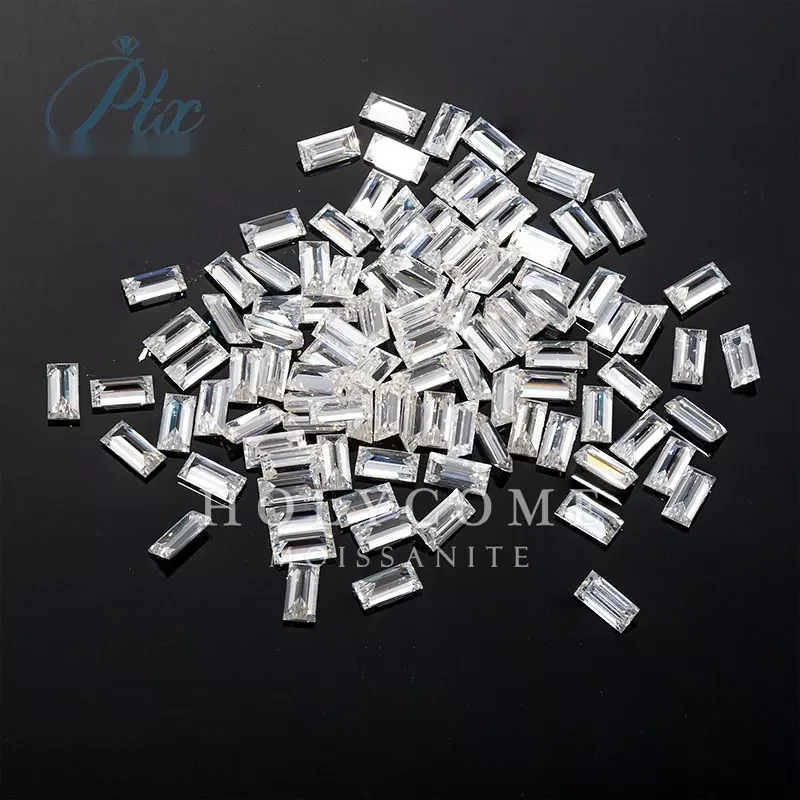
Moissanite pricing makes sense once you see it as a rough-to-cut equation. Every finished carat consumes more than two carats of rough, and the ratio depends on shape, rough quality and the cutter's commercial target.
The yield equation
Yield is finished weight divided by rough weight consumed. The remainder is lost to sawing, bruting, faceting and rejection.
| Shape | Typical yield | Why |
|---|---|---|
| Round brilliant | 38-45% | Symmetric recovery, least loss |
| Oval | 32-38% | Length retention, some waste at ends |
| Cushion | 34-40% | Rounded corners recover well |
| Pear | 28-34% | Tapered end loses material |
| Marquise | 25-31% | Two pointed ends, highest loss |
| Emerald step | 30-36% | Flat table, corner loss |
The ranges overlap because rough quality and target proportions move the number. A cutter chasing a larger table at the same carat will accept a lower yield to hit a commercial look.
Why the same carat has different prices
A 1 ct marquise consumes roughly 3.2 to 4 ct of rough. A 1 ct round consumes 2.2 to 2.6. At a rough cost of 11 USD per carat, the rough cost embedded in the finished stone differs by 10 to 18 USD, and that is before cutting labour.
Rough quality and the rejection rate
Moissanite rough carries internal characteristics that affect yield. Bubbles, striae and colour banding can force a cutter to reduce the target size or reject a piece mid-process.
Higher-grade rough costs more per carat and returns a higher yield. The two effects partly offset, which is why the cheapest rough does not produce the cheapest finished stone.
The rejection share
In a production run, 5 to 12 percent of pieces are lost to internal defects discovered during cutting. That loss is priced into the per-carat figure the buyer sees, whether the supplier itemises it or not.
Cutting labour and the shape premium
Moissanite is harder to cut than diamond in some orientations and softer in others, and the material's birefringence makes proportion control critical. Cutting labour per stone is therefore a real line, not a rounding error.
Fancy shapes take longer
A marquise requires two matched ends and a symmetric girdle. A pear requires a controlled taper. Both cost more bench time than a round, and the labour is priced per piece, not per carat.
- Round brilliant: baseline labour unit
- Oval and cushion: 10 to 20 percent more labour
- Pear and marquise: 25 to 40 percent more labour
- Emerald step: 15 to 25 percent more, plus higher rejection
Calibration: the step that changes everything
Calibrated stones are cut or sorted to a tight diameter band, typically plus or minus 0.05 mm. This step is what allows a setter to place 40 stones in a halo without re-cutting seats.
What calibration costs
Two costs: sorting labour, and the material lost when an off-size stone is re-cut down to the band. The second cost is the larger one, because a stone reduced by 0.1 mm loses visible weight.
Expect a 10 to 20 percent premium per carat for calibrated moissanite, and expect the premium to be larger on fancy shapes than on rounds.
When to skip calibration
Skip it when the setting is individual, such as a solitaire or a three-stone, where each seat is cut to the stone in hand. Calibration exists for repetition, and it is wasted on one-off pieces.
Colour and clarity in the cutting decision
Moissanite colour is graded on a different scale from diamond, and the cut affects how colour reads. A deeper pavilion concentrates colour; a shallower one can wash it out.
Clarity is usually high in moissanite, so the cutting decision is driven by colour and proportion rather than by inclusion avoidance. That is why two stones of the same grade can look different in the hand.
Birefringence and proportion choices
Moissanite is doubly refractive, which means light splits into two paths inside the stone. In practice the material looks slightly softer than diamond at the same cut, and it reveals internal facets through the table more visibly.
Cutters respond by adjusting the pavilion angle and the table size. A deeper pavilion concentrates the doubling effect and can look glassy; a shallower one reduces it and risks a window. The proportion target is therefore not a cosmetic preference, it is a material constraint.
Why a table of 56 to 58 percent is common
A table smaller than roughly 55 percent reduces brightness in a moissanite; a table above 60 percent increases the window risk. Cutters who target 56 to 58 percent are balancing brightness against doubling, and that target costs yield because it constrains how much weight can be kept.
What this means for a buyer
If a quote is unusually cheap for a round brilliant, ask for the table percentage. A 63 percent table keeps more weight from the rough, which lowers cost, and produces a stone with a visible window. The saving is real and the defect is real, and the two arrive together.
The same logic applies to depth. A shallow pavilion of 39 to 40 percent recovers weight but reduces the stone's ability to return light through the crown. Cutters who chase yield will drift toward these numbers, and a buyer comparing per-carat prices across suppliers is effectively comparing how much weight each cutter chose to sacrifice.
Ask for a photograph of three stones from the run side by side on a white card. Proportion drift shows immediately in a group, and it is almost invisible when stones are photographed one at a time.
Colour also drifts with proportion. A deeper stone concentrates body colour and reads one grade warmer than a shallow stone of the same rough. When a buyer compares two suppliers on price, part of the difference may be that one is selling a warmer-reading stone at the same nominal grade.
Inspect stones on a white card under north-facing daylight before judging colour. A bench lamp with a warm cast flatters every stone and hides the drift that shows up in a customer's hand.
- Table 56-58 percent: balanced, standard for good rounds
- Table above 60 percent: higher yield, window risk
- Table below 54 percent: smaller face-up look, brightness loss
How to compare moissanite quotes
Four fields make a quote comparable. Ask for all four before comparing totals.
| Field | What it should state |
|---|---|
| Shape and proportion | Named cut with table and depth target |
| Colour grade | Scale used, with a tolerance range |
| Calibration | Calibrated or sieve-range, with tolerance |
| Certificate | Card, full report, or none |
A quote that omits the proportion target is quoting a weight, not a stone. Two 1 ct rounds with different depth can look 0.2 mm different in diameter, and that is a visible difference in a setting.
What our cutting terms look like
We quote moissanite by shape, colour grade and calibration status, with the proportion target stated for custom cuts. Minimum order is 50 pieces per design for jewelry and one parcel for loose stones.
Stock shapes ship in three to five days. Custom cutting, including non-standard shapes and sizes, runs about 20 days for a sample and 25 to 30 days for a following bulk lot. Payment is a 30 percent deposit with the balance before shipment, by T/T, PayPal or Western Union.
For custom cuts we provide a photograph of the first piece against a gauge before the run continues, so a proportion error is caught at one stone rather than at three hundred.
Frequently Asked Questions
Is moissanite cutting yield worse than diamond?
Broadly similar for rounds, and worse for fancy shapes because moissanite rough is often produced in shapes that favour rounds. The material's birefringence also constrains proportion choices.
Can a cutter hit an exact carat weight?
Within a range, not exactly. Cutting to a precise weight wastes material and usually produces a poorer proportion. Specify a weight range and a diameter, and let the cutter optimise within it.
Why do calibrated stones sometimes weigh less than quoted?
Because calibration may re-cut a stone down to the band. The finished weight reflects the band, not the original target, and the difference should be stated on the invoice.
Do fancy shapes need a certificate?
For loose stones above 1 ct sold to retail, a card or report supports the sale. For melee, a parcel specification is standard and a per-stone report is not economic.
Record the rough weight against the finished weight for every lot, even when the result is unwelcome. A supplier who can show a yield history is a supplier a buyer can forecast with, and forecasting is what allows a price to be agreed before the rough is cut rather than after the stones are in hand.
Next step
Send the shape, carat range, colour grade and whether the setting repeats, and we will quote the calibrated and uncalibrated options with the yield basis stated. Start with our stone desk, or read the guide index for setting and metal context.


