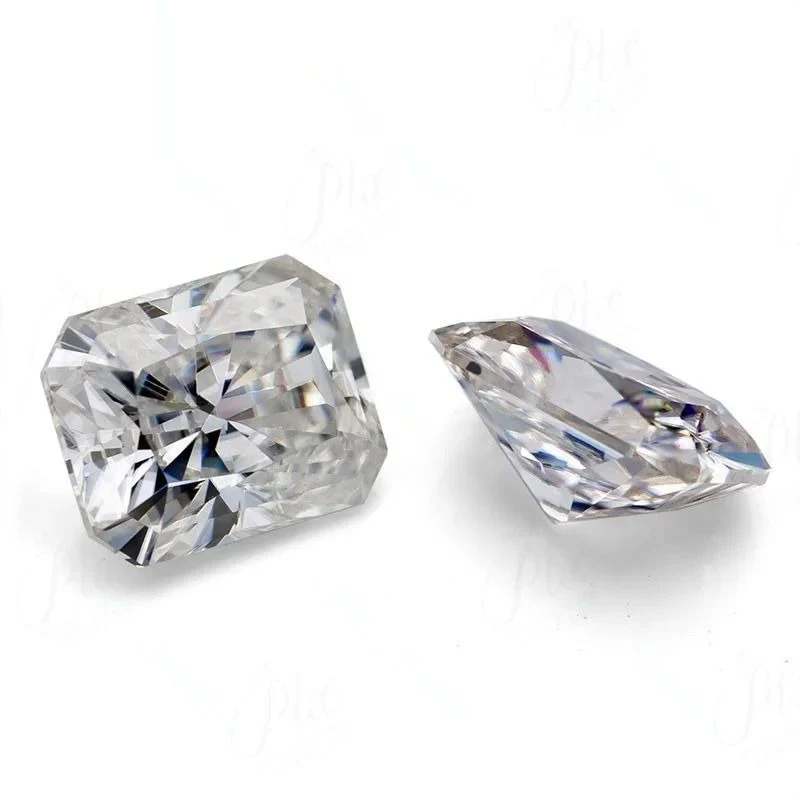
A customer asks for a one-carat moissanite and expects it to match a one-carat diamond they saw in a case. It does not, and the reason is that carat measures weight while the eye measures width. Moissanite is less dense than diamond, so a stone that weighs one carat actually measures slightly wider across the table than a one-carat diamond of the same cut. For a retailer, quoting carat without the millimeter measurement invites the it-looks-bigger conversation. Here is the chart and why it matters.
Why carat is not the same as size
One carat is 0.20 grams, a unit of weight. Two stones of equal carat can look very different if one is cut deep (weight hidden in the pavilion) and another shallow (weight spread across the table). Moissanite's specific gravity is lower than diamond's, which means for the same weight it occupies more volume. The weight unit is defined on the carat reference entry. In practice, a round brilliant that weighs about 1.0ct in moissanite measures roughly 6.5mm across, close to a diamond's 6.5mm 1ct, but in ovals and pears the moissanite millimeter measurement tends to run a touch wider for the same labeled carat. For the visual side, see carat size versus finger size on the hand.
The rough millimeter chart by shape
Round brilliant: a 6.5mm stone is marketed as roughly 1.0ct equivalent, an 8mm stone as about 2ct equivalent, and a 9.5mm stone as 3ct equivalent. Oval follows proportionally, around 8x6mm at the 1ct equivalent and 10x7mm near 2ct. Pear and marquise carry more length for the same width, so they read larger still. Princess and cushion sit between round and oval. The key for stock is to label by millimeter first and carat equivalent second, because that is what the customer actually compares on their finger. Shape comparisons are in carat size comparisons across shapes.
Why moissanite reads larger per carat
Because of the lower density, a moissanite marketed as 1ct equivalent is sized to look like a 1ct diamond face-up rather than to weigh exactly 0.20g. This is a feature for buyers who want maximum finger presence per dollar, but it means a customer who wants a true weight comparison to a diamond will be briefly surprised. It also means pricing is usually quoted by millimeter or by equivalent carat rather than strict carat weight. Stock calibrated stones in fixed millimeter steps so settings fit cleanly. For the value angle, read moissanite versus cubic zirconia and how carat choice fits the budget.
How to talk size to a buyer
Skip the carat-vs-weight debate and put a ruler on it. Tell the buyer the millimeter width of the stone, let them picture it against their own finger width, and show a photo of that millimeter size on a similar hand. A 6.5mm round on a size 6 finger reads one way; the same stone on a size 8 finger reads smaller. Matching millimeter to finger width is the conversation that ends returns.
How finger width changes what a carat looks like
The same 6.5mm stone reads very differently across a size 5 finger than across a size 9. On a narrow finger, a round over 7mm can look oversized and heavy; on a wider finger, a 6.5mm stone reads modest. This is why a millimeter chart is more useful than a carat chart: it lets the buyer match the stone width to their own finger rather than to an abstract weight. A practical rule is to let the stone cover about half to two-thirds of the finger width. If a customer wants a bold look, they can push the stone to fill most of the finger; if they want a quiet daily piece, keep the table under two-thirds. Always show the on-hand photo at the chosen millimeter size, because the chart alone flatters every stone.
Is a 1ct moissanite the same size as a 1ct diamond?
Close in width for a round (around 6.5mm), but moissanite's lower density means it often measures a touch wider face-up for the same labeled carat. Millimeter measurement is the honest comparison.
What mm is a 2ct moissanite?
A round 2ct-equivalent moissanite is typically about 8mm across, with ovals and pears running slightly longer for the same width.
Does a bigger carat always look bigger on the hand?
No. A deep-cut stone hides weight in the pavilion and can look smaller face-up than a shallower stone of the same carat. Millimeter table width is what reads.
Should I buy moissanite by carat or by mm?
Buy by millimeter to match the setting and the finger, then quote the carat equivalent to the customer. Calibrated mm stones fit standard mounts cleanly.
If you are a jeweler ordering calibrated moissanite, our wholesale team supplies stones in fixed millimeter steps with matching equivalent-carat labels and on-hand photos. Request the mm size chart.
Frequently Asked Questions
Is moissanite a good diamond alternative for retail buyers?
Yes for price-sensitive customers who want brilliance and hardness. Moissanite ranks 9.25 on the Mohs scale, holds up to daily wear and costs a fraction of a natural diamond of the same size, so it resells fast in bridal and fashion lines.
What is the minimum order for wholesale moissanite?
MOQ starts at 50 pieces per design for stock items. Custom cuts and private-label settings usually start at 100–300 pieces depending on the mold.
Do you provide certificates with moissanite stones?
Yes. Every parcel ships with GRA or IGI documentation listing carat weight, color grade and cut. We recommend passing the certificate to your end customer for trust.
How long does sample and bulk production take?
Samples ship in 3–5 days. Bulk runs take 15–20 days under 500 pieces, and 25–30 days for custom work.


