A jeweller engraved 120 rings with a supplier's default font and a 1.6 mm character height. Half of them read as a blur because the text ran past the curve of the shank, and the batch had to be polished out and redone. The engraving was correct in the file and wrong on the ring.
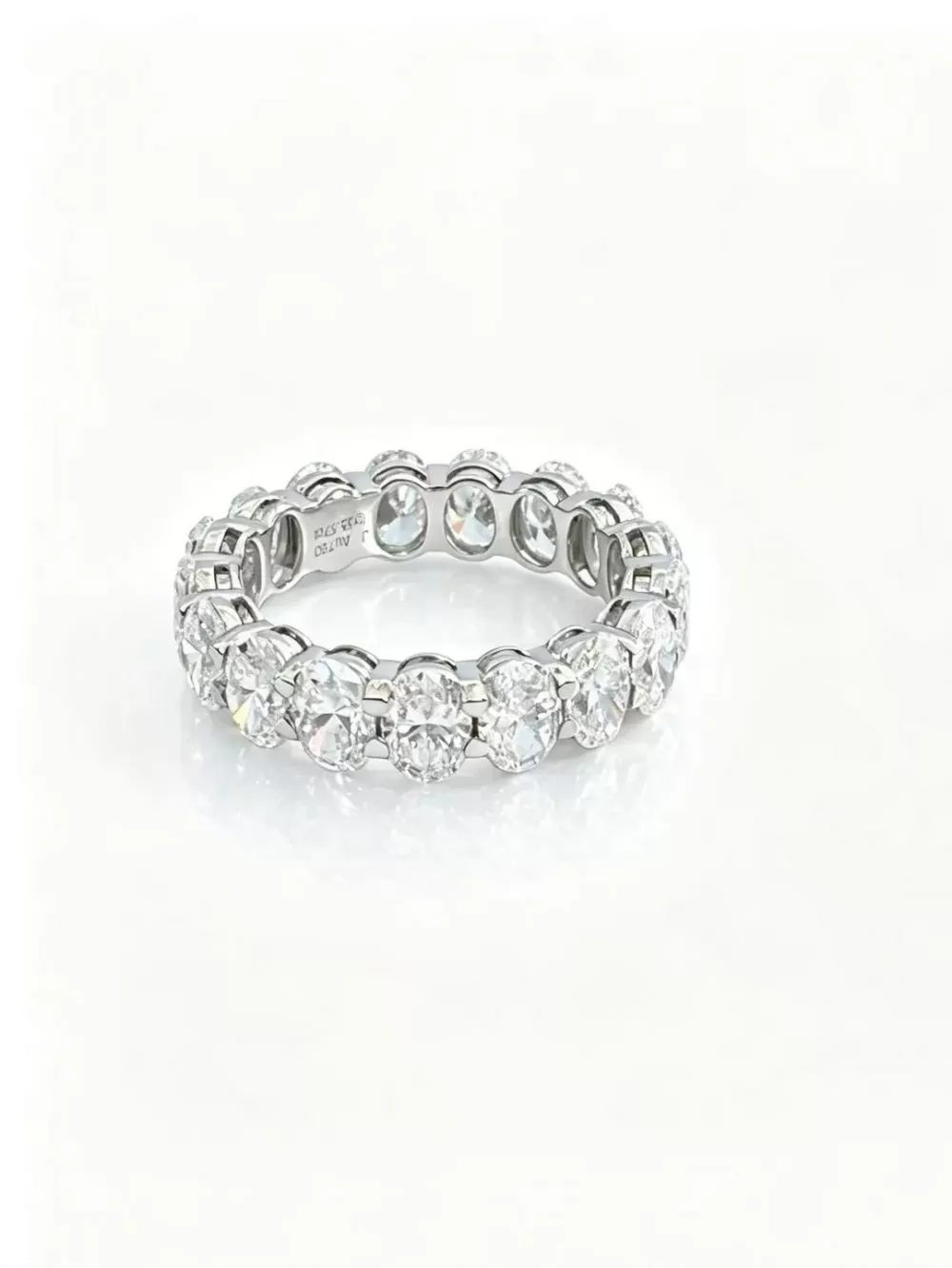
Engraving is the last production step and the only one with no reverse. A ring can be replated or resized, and an engraving can only be removed by polishing away metal. That makes it the step that deserves a written approval.
How laser engraving works on a band
A laser removes a thin layer of metal along a path defined by a vector file. The result is a mark with a defined depth and edge quality, and both depend on the file and the settings.
Fiber versus YAG
A fiber laser is the usual tool for metal. It produces a fine, high contrast mark on silver and gold, and depth is controlled by power and pass count rather than by a single setting.
Why the curve matters
The inside of a band is curved in two directions. A flat engraving plan projected onto that surface stretches at the ends, so text that fits a flat layout runs past the edge on the ring. The file has to be laid out on the curve, not flattened onto it.
Depth, legibility and wear
Depth decides whether the engraving is still readable in five years.
| Depth | Legibility life | Use case |
|---|---|---|
| 0.03-0.05 mm | 6-12 months | Light personalization, thin bands |
| 0.08-0.12 mm | 3-5 years | Standard wedding band engraving |
| 0.15-0.20 mm | 5 years and up | Wide bands, initials or dates |
A shallow mark reads well on delivery and fades as the interior polishes against the finger. A deep mark stays readable and removes metal, which matters on a 2 mm shank where the wall is already thin.
The height of the characters
Character height, not depth, decides whether the text is legible at all. Below about 0.8 mm, most fonts lose the distinction between similar letters, and a date reads as a smudge.
Font choice
A simple sans serif with open counters engraves cleanly at small size. A script font with thin strokes loses its connectors and reads as a chain of dots. The font should be chosen for the size, not for how it looks on a screen.
Placement on the band
Placement is a design decision with practical limits. The inside of the shank is the standard position because it is protected from wear and visible only to the wearer.
Centring against the stone
On a stone set band, the engraving should be centred opposite the main stone so it sits in the widest clear area. Placing it under the setting puts the text against the stone seat, where it is hard to read and easy to damage during a resize.
Clearance from the edges
Leave at least 0.5 mm from each edge. Text that runs to the edge is removed by a polish and it catches on the skin during wear.
Multiple lines
Two lines fit on a 6 mm band and rarely on a 4 mm band. A second line is usually a date and two initials, and it needs the wider band to stay legible.
File preparation
The file is where most engraving errors are created. Four checks catch them before the laser runs.
Vector, not bitmap
A vector path scales cleanly and a bitmap does not. A 300 dpi bitmap looks acceptable on screen and produces ragged edges at band scale, because the mark is only a fraction of a millimetre wide.
Text as outlines
Converting text to outlines removes any dependency on the font being installed on the engraver's machine. A live text layer with an unembedded font substitutes a different face and changes the width of the line.
Confusing characters
O and 0, l and 1, and rn versus m are the pairs that produce a wrong reading. On a band, where the text is small and curved, the confusion is common enough to justify a written confirmation.
- Vector format, no bitmaps
- Text converted to outlines
- Character height stated in millimetres
- Spelling confirmed in writing by the buyer
The approval loop
For a volume order, the approval loop is what prevents a batch of misengraved rings. It has three steps and it takes one day.
- Buyer supplies the text and the layout in a vector file
- Supplier returns a proof image at true band scale
- Buyer approves in writing, then production runs
The proof at true scale is the critical step, because a layout that looks correct at poster size fails at 4 mm. A proof rendered at the actual band width shows the failure before 120 rings are marked.
Engraving a test piece
On a first order, engrave one ring and photograph it before running the batch. The test costs one piece and it catches font, depth and placement problems that a flat proof cannot show.
Engraving and plating
Engraving after plating removes the plate inside the mark, which exposes the silver beneath and produces a mark that darkens with tarnish. Engraving before plating leaves a plated mark that stays white but loses some definition.
The usual order
Engrave before plating on a plated programme. The mark is then covered by the plate and it resists tarnish, and the depth is reduced by the plate thickness by a predictable amount.
Engraving a plated piece
When a piece is engraved after plating, the exposed silver in the mark tarnishes and the text darkens. Where a dark mark is the intent, that is an advantage; where it is not, it reads as a defect.
Cost and turnaround at volume
Laser engraving is fast and cheap per unit once the file is set. Cost is dominated by setup and handling rather than by laser time.
Setup versus run
Fixturing the band, loading the file and running the first test is the setup. Each additional ring takes seconds. A batch of 100 costs little more than a batch of 20 once the setup is done.
Handling is the real cost
Each ring must be mounted, aligned and removed without scratching. At volume, handling time exceeds laser time, which is why engraving is usually priced per piece with a setup charge.
| Cost element | Scales with |
|---|---|
| Setup and proof | Per order, not per piece |
| Laser time | Per character count |
| Handling | Per piece |
| Rework | Per error, and high |
What to write into a supply agreement
Three clauses remove most engraving disputes. They fit on half a page.
Approval clause
Production begins only after written approval of the true scale proof. An order approved by phone or by a verbal yes carries the risk of a misread, and the supplier cannot be expected to absorb it.
Character limit clause
State the maximum character count per band width. A buyer who asks for thirty characters on a 2 mm band is asking for a mark that will not read, and the limit is a service rather than a restriction.
Rework clause
Errors caused by the supplied file are corrected at the buyer's cost, and errors caused by the engraver are corrected at the supplier's cost. That split is fair and it is easy to apply when a proof exists.
What our engraving terms look like
We engrave inside the shank as standard at 0.10 mm depth and 1.0 to 1.2 mm character height, and we return a true scale proof for written approval before production. Fonts are converted to outlines and the buyer confirms the spelling.
Minimum order is 50 pieces per design. Stock ships in three to five days and bulk in fifteen to twenty days under 500 pieces, with engraving adding one to two days. Payment is a 30 percent deposit with the balance before shipment, by T/T, PayPal or Western Union. Engraving is quoted per piece plus a one time setup.
Frequently Asked Questions
Can a misspelled engraving be fixed?
Only by polishing out the mark and re-engraving, which removes metal and may require replating. On a thin band the correction can be visible, which is why the written approval exists.
Does engraving weaken a band?
A 0.10 mm mark on a 1.2 mm wall removes about eight percent of the thickness at that point. On a 2 mm band with a thin wall, a deep mark is a real weakening and should be kept shallow.
Can I engrave a stone set band inside?
Yes, opposite the main stone, and clearance from the setting matters. Engraving under the setting risks damage during a resize or a prong repair.
Is hand engraving still available?
Yes, for a different price and a different look. Hand engraving cuts a wider, brighter mark and takes far longer, so it suits a small number of high value pieces rather than a volume order.
Next step
Send your engraving text as a vector file and we will return a proof at true band scale. Our production desk handles the approval loop, and the guide index covers band profiles and sizing.


