A retailer listed a moissanite ring as "GRA certified diamond alternative" and received a complaint within a month. The stone was correctly described as moissanite elsewhere on the page, but the phrase did the damage. The document attached to the order was a GRA card, and the customer read "certified" as a guarantee the card does not make.
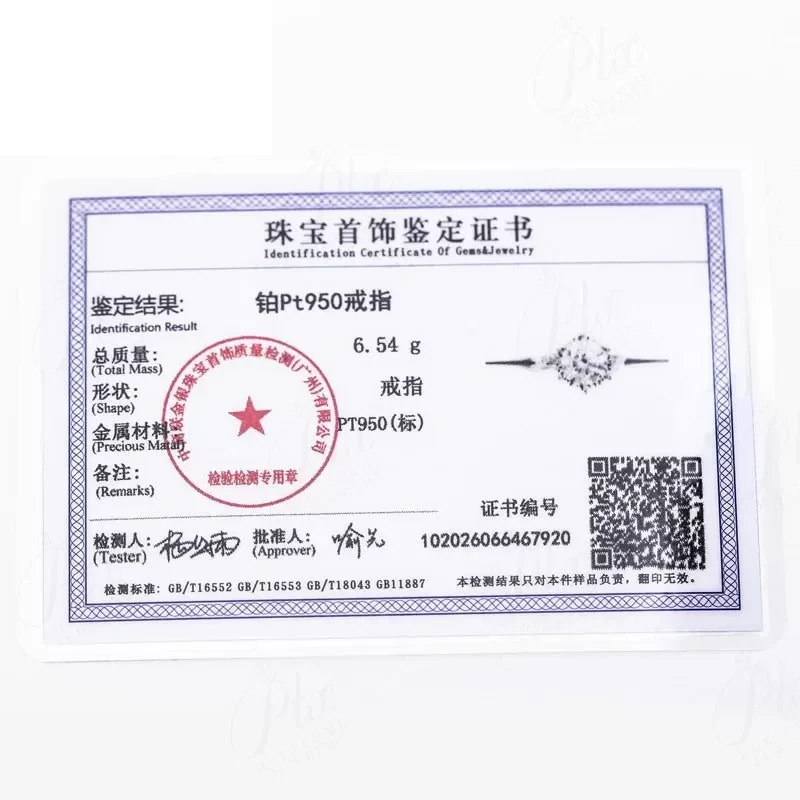
The lesson is not about which document is better. It is about what each document actually verifies, and what a marketing sentence is allowed to claim on the back of it.
What a GRA card contains
A GRA card, issued by the producer rather than an independent laboratory, typically states the stone's weight, colour grade, clarity grade, cut and a report number. It often includes a QR code and a verification page.
The card is a specification record. It says the producer asserts these grades for this stone. It is not an independent measurement, and it does not plot inclusions or diagram proportions.
What the card is useful for
- Confirming the carat weight at the point of sale
- Giving the customer a number to match against the invoice
- Supporting a colour and clarity claim in a listing
- Providing a paper trail if a grade dispute arises
What the card does not do
The card does not verify that the stone is moissanite rather than another simulant, does not grade cut quality against a published proportion standard, and does not establish an independent record that a third party can rely on.
What an IGI report adds
An IGI report comes from a laboratory with a grading operation and a published method. On moissanite it typically records measurements, proportions, a plotted diagram where relevant, and the material identification.
Independent measurement
The key difference is independence. A laboratory measures the stone against its own equipment and standards, and the resulting document is a third-party record rather than a producer statement. That matters in a dispute and it matters in a listing where a customer asks who graded the stone.
Proportion data
A report that includes table percentage, crown height and pavilion depth gives a buyer something to compare. A card without proportions cannot support a claim about cut quality, only about grade.
| Feature | GRA card | IGI report |
|---|---|---|
| Issued by | Producer | Independent laboratory |
| Weight and grade | Yes | Yes |
| Measurements | Sometimes | Yes |
| Proportions | Rarely | Yes |
| Plotting | No | Yes where relevant |
| Cost per stone | Low | Higher |
The cost difference is the reason most moissanite below 0.5 ct ships with a card rather than a report. At that size, the report cost can exceed the stone cost.
Where the compliance risk sits
Moissanite is silicon carbide. It is not diamond, and US jewelry advertising guidance treats an unqualified "diamond" claim on a non-diamond as deceptive. Phrases that create risk include "diamond alternative" used alone, "certified diamond", and "lab diamond" applied to moissanite.
Language that works
- Moissanite, silicon carbide, with the grade and carat stated
- Moissanite with a GRA specification card
- Moissanite, independently reported by IGI where a report exists
Language to avoid
Avoid "simulated diamond" without a clear statement that the stone is moissanite, avoid "certified" as a standalone adjective, and avoid implying that a card is a laboratory report. The FTC Jewelry Guides are the reference most US retailers build policy on, and matching their vocabulary keeps your listing compatible with your customer's compliance review.
Choosing a document per product tier
The right document depends on the price of the piece and the expectations of the channel.
| Product tier | Document | Reason |
|---|---|---|
| Melee and fashion under 200 USD | Parcel spec, no card | Cost exceeds benefit |
| Fashion 200-600 USD | GRA card | Supports grade claim |
| Bridal 600-2,000 USD | GRA card plus proportions | Customer asks about cut |
| Premium above 2,000 USD | IGI report | Independent record expected |
Tiering the document keeps cost proportional to the transaction and avoids the situation where a 90 USD pendant carries a 40 USD report.
Verification habits
Three checks catch most document problems before a customer does.
- Scan the QR code and confirm the returned weight and grade match the physical stone
- Weigh the stone on a calibrated scale and compare with the stated carat
- Confirm the material identification line says moissanite, not diamond
The third check is the one that prevents a listing error. A card that identifies the material correctly protects the retailer; a card that omits the material line leaves the claim to the marketing copy.
What our documents look like
We ship moissanite with a GRA card as standard on center stones above 0.3 ct, and we can supply an IGI report on request for stones above 1 ct. The card states carat, colour grade, clarity grade and the report number, and the packing list states the material as moissanite.
Minimum order is 50 pieces per design for jewelry and one parcel for loose stones. Stock ships in three to five days, bulk in fifteen to twenty days under 500 pieces. Payment is a 30 percent deposit with the balance before shipment, by T/T, PayPal or Western Union.
Writing the listing
The listing should carry the material, the grade, the carat and the document. Four facts, no adjectives that outrun them.
A sentence that works: "1 ct moissanite, colourless grade, GRA specification card included, set in 925 sterling silver." A sentence that creates risk: "certified diamond-look stone, guaranteed to pass a diamond tester." The second claim is both false and unnecessary.
What the document does for a listing
A document is not decoration. It answers a question the customer will ask, and it answers it before the sale rather than after.
Questions a card answers
A card answers the carat question, the colour question and the clarity question. Those three cover the majority of pre-sale messages on a moissanite listing, which is why a card reduces support load even when it adds no legal weight.
Questions a report answers
A report answers the cut question. When a customer asks why one 1 ct stone looks brighter than another, a proportion line gives the retailer something concrete to point at. A card cannot answer that, and the salesperson is left with adjectives.
Cost and document choice
Report costs are per stone and do not scale with order size in the way that stone cost does. That makes the decision a ratio rather than a policy.
| Stone value | Card cost share | Report cost share |
|---|---|---|
| Under 30 USD | 5-8% | 40%+ |
| 30-80 USD | 2-4% | 15-25% |
| 80-200 USD | 1-2% | 6-12% |
| Above 200 USD | Under 1% | 3-6% |
The table explains why report use concentrates above 200 USD per stone. Below that, the document cost is a visible share of the price and the customer is usually buying a finished piece rather than a stone.
The middle tier problem
Between 80 and 200 USD, both documents are defensible. The deciding factor is the channel: a marketplace listing benefits from the report because it differentiates against untrusted competitors, while a direct-to-consumer brand benefits from the card and puts the money into photography instead.
Frequently Asked Questions
Can a GRA card be verified online?
Usually yes, through a verification page and the report number. Verify before listing, because a card that does not resolve is worse than no card.
Is IGI grading stricter than a producer card?
It is independent rather than stricter. Independence is the value, because a producer grades its own product.
Do customers care which document they receive?
Some do, particularly above 1,000 USD. Below that, most care that the document exists and matches the stone. Match the document to the price tier rather than to a general policy.
Should I include the document in product photos?
Yes for bridal and premium tiers. It answers the documentation question visually and reduces pre-sale messages. Do not photograph a card that belongs to a different stone.
What buyers ask most
Three questions come up in almost every conversation about moissanite documents. Answering them in the listing removes most of the pre-sale message traffic.
Is this a real diamond?
No, and the listing should say so plainly. Moissanite is silicon carbide, it is a different material, and a clear statement builds more trust than a hedge. Customers who want a diamond are not persuaded by ambiguity, and customers who want moissanite are reassured by clarity.
What does the card prove?
It proves the producer asserts a weight, a colour and a clarity for a specific stone, with a number that can be checked. It does not prove independent grading. Say that in the listing and the customer's expectation matches the document.
Will the colour change?
As-grown and bulk-treated colour is stable. Coated colour can thin under abrasion and ultrasonic cleaning, and the listing should say so where it applies. This is the question that drives most treatment-related returns, and a listing that answers it in advance keeps the return rate down.
Next step
Tell us the tier and the channel, and we will quote with the document that fits it. Start with our stone desk, or read the guide index for setting and metal decisions.


