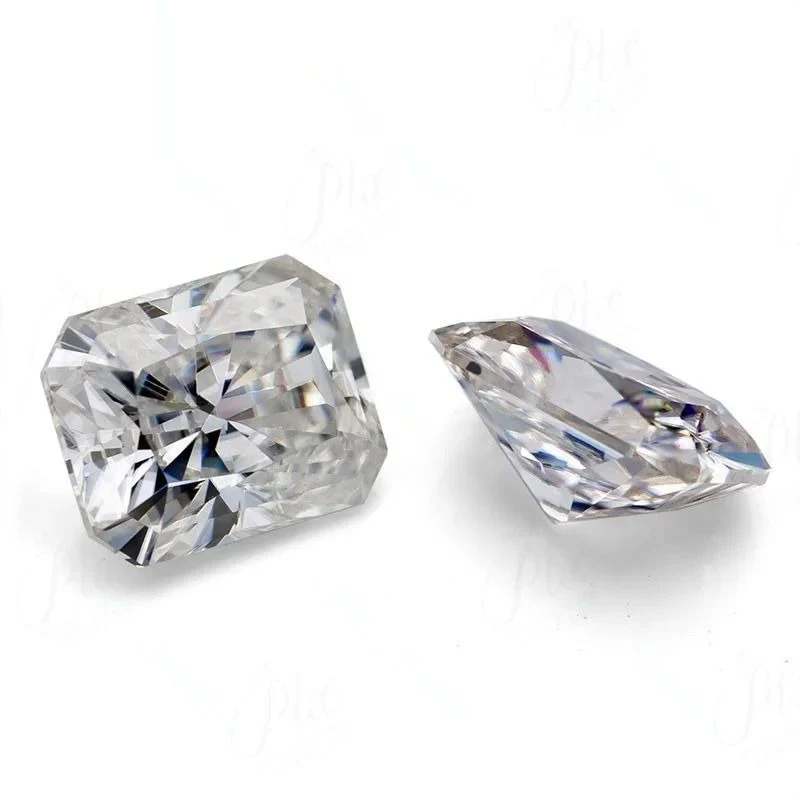
A buyer holds a 1.00ct diamond next to a 1.00ct moissanite and asks why the moissanite looks bigger. The carat weight says they match. The eye says otherwise. The answer is density: moissanite is less dense than diamond, so the same weight takes up more physical space. This matters when a buyer expects a moissanite to match the visual size of a diamond by the same carat number. It does not.
The density math behind the mismatch
Diamond density runs about 3.52 grams per cubic centimeter. Moissanite sits around 3.22 g/cc. The moissanite reference and the diamond reference list these figures. A moissanite of the same weight as a diamond therefore occupies roughly 9 to 12 percent more volume. On the hand, that translates to a 6.5mm round diamond (about 1.00ct) sitting beside a 6.5mm moissanite that weighs closer to 0.88ct. Or, reversed, a 6.5mm moissanite that weighs 1.00ct looks slightly larger than a 6.5mm diamond of the same weight. This is why moissanite is sold by millimeter size as often as by carat.
Why moissanite is sold by mm instead of carat
Because carat is a unit of weight, not size. A buyer who shops by carat alone on moissanite overpays for a look they could get at a lower weight. The trade convention is to label moissanite by millimeter (6.5mm, 7.5mm, 8mm) and list the approximate diamond-equivalent carat in parentheses. For example, a 6.5mm round moissanite is marketed as roughly a 1ct diamond equivalent. Read the moissanite mm-to-carat chart and diamond carat size in millimeters to see the two systems side by side.
What this means for pricing and stock
Stockers should buy moissanite by the millimeter size they want on the hand, not by chasing a carat number. A 7.5mm round moissanite that weighs 1.2ct looks like a 1.5ct diamond to the eye, which is the selling point. The buyer gets a larger-looking stone for less. The risk is over-weighting a moissanite to hit a carat target the buyer will never see as size. Cross-reference with carat size versus finger size and 1ct versus 2ct on the hand.
The honesty point with the carat number
Do not tell a buyer a 1.00ct moissanite equals a 1.00ct diamond on the hand. It does not. Tell them the millimeter size and the diamond-equivalent look. That honesty builds trust and prevents returns when the buyer compares their moissanite to a friend's diamond. The carat weight of a moissanite is a technical spec, not the selling size. For the wider comparison, see moissanite versus CZ and moissanite versus white sapphire.
How the density difference affects setting and stock
Because moissanite is lighter for the same visual size, it also sits differently in a setting. A prong that holds a 6.5mm diamond securely holds a 6.5mm moissanite the same way, because the seat is cut to the millimeter, not to the weight. But the moissanite stone costs less per millimeter, which means a buyer can step up from a 1ct look to a 1.5ct look on the same setting budget. For stockers, the practical move is to buy moissanite by the millimeter and keep a chart that maps 5mm, 6.5mm, 7.5mm, and 8mm to their diamond equivalents. Do not stock by carat weight on moissanite, because a 1ct moissanite and a 1ct diamond fill different seats. When a client asks for a 1ct solitaire in moissanite, hand them the 6.5mm stone and explain that it matches the visual size they asked for, not the scale weight. That framing prevents the disappointment of a buyer who expected a 1ct diamond-sized stone and received something smaller because they shopped by the wrong unit.
One more stock note: because moissanite density is lower, a 1ct moissanite also weighs less on a jeweler's scale, so do not weigh a moissanite and a diamond of the same millimeter side by side and assume one is underweight. The scale reads the truth, but the unit of truth is different for each material. When a customer asks why their 1ct moissanite feels lighter than their friend's 1ct diamond, the answer is density, not a short weight. The stone is the right size; it simply occupies its weight with more volume and less mass.
Is a 1ct moissanite the same size as a 1ct diamond?
No. Moissanite is less dense, so the same weight occupies more space. A 1ct moissanite looks slightly larger than a 1ct diamond on the hand.
Why is moissanite sold by millimeter?
Because buyers shop by visual size, not weight. Moissanite's density differs from diamond, so millimeter sizing gives an honest size equivalent.
What mm is a 1ct moissanite equivalent to?
A round moissanite around 6.5mm weighs roughly 1ct and is marketed as a 1ct diamond equivalent in visual size.
Should I pay more for a heavier moissanite?
No. Buy by the millimeter size you want on the hand. Chasing a higher carat weight on moissanite does not buy you a larger-looking stone.
If you are a jeweler stocking moissanite by millimeter sizes, our wholesale team can supply matched mm-to-carat parcels with size charts. Request a moissanite size sample.
Frequently Asked Questions
Is moissanite a good diamond alternative for retail buyers?
Yes for price-sensitive customers who want brilliance and hardness. Moissanite ranks 9.25 on the Mohs scale, holds up to daily wear and costs a fraction of a natural diamond of the same size, so it resells fast in bridal and fashion lines.
What is the minimum order for wholesale moissanite?
MOQ starts at 50 pieces per design for stock items. Custom cuts and private-label settings usually start at 100–300 pieces depending on the mold.
Do you provide certificates with moissanite stones?
Yes. Every parcel ships with GRA or IGI documentation listing carat weight, color grade and cut. We recommend passing the certificate to your end customer for trust.
How long does sample and bulk production take?
Samples ship in 3–5 days. Bulk runs take 15–20 days under 500 pieces, and 25–30 days for custom work.


